Apartment prices in Seoul's Seongbuk district rose 16.52% in about a year. Over the same period, prices in Gangnam rose 1.40%. Measured by the rate of increase, Seongbuk rose about 11.8 times as fast as Gangnam. These are cumulative increases measured by the Korea Real Estate Board from Oct. 20, 2025, to Oct. 5, 2026.
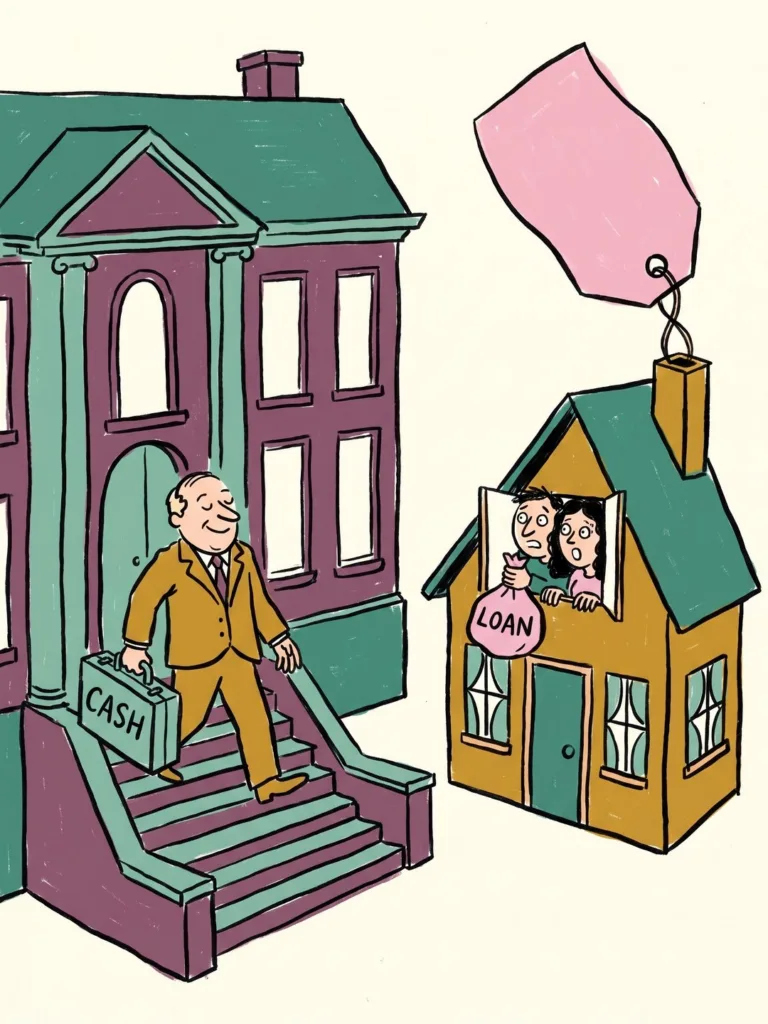
The common reading is that the Oct. 15, 2025, measures cooled Gangnam's overheated market. But the real story is elsewhere. Analysts say the loan caps, which set how much you can borrow based on a home's price, split buyers by the homes they could afford.
The pricier the home, the smaller the loan → young buyers short on cash turned to mid- and lower-priced neighborhoods → prices there rose faster.
- How did the Oct. 15 measures change mortgages?
On Oct. 15, 2025, the government put all 25 districts of Seoul and 12 areas of Gyeonggi Province under regulated-area rules (tighter loan and tax rules) and land transaction permit zones (where buyers must move into the home they purchase). It also split mortgage limits into three tiers by home price.
Homes worth up to 1.5 billion won (about $1.1 million) can get a mortgage of up to 600 million won (about $450,000). Homes above 1.5 billion won and up to 2.5 billion won (about $1.9 million) get up to 400 million won (about $300,000), and homes above 2.5 billion won get up to 200 million won (about $150,000). Under the earlier June 27 lending rules, the cap for buying a home in the Seoul area and regulated areas was a flat 600 million won. Put simply, the more expensive the home, the less the bank will lend.
- Why a $75,000 price gap becomes a $225,000 cash gap
Assume you borrow up to the cap (a hypothetical calculation that ignores income and other loan conditions). A 1.5 billion won home lets you borrow 600 million won, so you need 900 million won (about $670,000) in cash. A 1.6 billion won home (about $1.2 million) lets you borrow only 400 million won, so you need 1.2 billion won (about $900,000) in cash. The homes differ in price by 100 million won (about $75,000), but the cash you need differs by 300 million won (about $225,000).
Yonhap News Agency noted that buying a home in Gangnam and the main popular neighborhoods along the Han River became something only the "cash rich" can do.
Think of it like height limits at an amusement park. Once people know which rides they can get on, they all line up there. The difference: a ride's price stays the same however long the line gets, but when more people want to buy a home, its price goes up.
- So which neighborhoods did the money go to?
Young buyers short on funds turned to mid- and lower-priced districts, where many homes are listed at 1 billion won (about $750,000) or less (Yonhap's analysis). Over the same period, Seongbuk rose the most (16.52%), followed by Seodaemun (14.40%), Gangseo (14.39%) and Guro (13.69%). The Seoul average was 10.42%.
Gangnam, by contrast, rose only 1.40% and Seocho 3.35%. Kim Hyo-sun, chief real estate expert at KB Kookmin Bank, said, "As the Oct. 15 measures designated a wide area as regulated all at once and mortgage limits shrank for pricier homes, housing demand split by price," adding, "Demand has concentrated in mid- and low-priced areas, so it is hard to say price gains have been fully blocked."
Loans are not the only reason Gangnam rose less. In January 2026, the government confirmed that a grace period sparing owners of multiple homes from a higher capital gains tax rate would end on May 9. Owners in Gangnam then put homes up for quick sale to save on tax, and prices there were weak for a while.
- What exactly does "10 times" compare?
Dividing 16.52% by 1.40% gives about 11.8 times. But that compares the rates of increase, not the amounts. If a 1 billion won Seongbuk apartment rises 16.52%, it gains about 165.2 million won (about $123,000). If a 3 billion won Gangnam apartment rises 1.40%, it gains 42 million won (about $31,000) (home prices are hypothetical). In this example, the gap in won is about 4 times.
- What happens when cheaper homes get more expensive?
Even a cheaper home can cross into a lower loan tier once its price rises. At Lotte Castle Classia in Gireum-dong, Seongbuk, a 59-square-meter unit (smaller than the common 84-square-meter size) traded for more than 1.5 billion won (about $1.1 million). The loan cap for that home is now 400 million won (about $300,000). A home people sought out because the loan was generous has become one where the loan shrinks.
Jeonse deposits moved too. Seoul jeonse prices (a Korean lease where tenants pay a large lump-sum deposit instead of monthly rent) rose 9.96% over the same period, and Seongbuk led Seoul at 15.64%.
- What changes next?
The land transaction permit zones run until the end of 2026. Land Minister Hong Ji-sun told a parliamentary audit on Oct. 7, 2026, "Given the current situation, we see that there is some degree of demand for the permit system," leaving open the possibility of an extension.
In past Seoul downturns, when prices in the three Gangnam-area districts (Gangnam, Seocho and Songpa) fell first, buyers waited on the sidelines, deals dried up, and the slowdown spread across Seoul. This time, even while Gangnam was weak from quick sales, mid- and lower-priced districts kept rising. Real estate commentator Yoon Ji-hae said the permit zones did block speculative demand (buying just to profit from rising prices) and sharply cut deal volume, but noted, "Since the measures were meant to curb speculative demand in the first place, unless the government regulates real buyers, it may be unclear what further measures it can offer."
- BITPRESS Insight
Loan rules were not a lid on all home prices but doors of different widths for each price range. Analysts say people crowded toward the wider doors, and those homes rose more. The scorecard after about a year: Seongbuk 16.52%, Gangnam 1.40%.
For first-time buyers, that is an uncomfortable fact. The price range you can afford is the range that people in your situation can afford too. When rules block expensive homes, your competitors do not disappear; they may come your way.
The rule of thumb is simple. When you see news about loan limits, before asking "Will prices calm down?" ask "Where will the people who were blocked go?" If that is where you plan to buy, the rule may end up adding to your competition.
Sources
https://www.yna.co.kr/view/AKR20261010045100003
https://www.mt.co.kr/economy/2026/10/08/2026100815360412966
Glossary
Oct. 15 housing measures — Real estate measures the government announced on Oct. 15, 2025, placing all of Seoul and 12 Gyeonggi areas under regulated-area rules and permit zones and setting loan caps by home price.
Mortgage — A loan you get by putting up the home you buy as collateral.
Land transaction permit zone — An area where buying a home requires permission and the buyer must live in it.
Cumulative increase — How much a price rose in total, in percent, from a chosen start date to an end date.
Owner-occupier buyer — Someone buying a home to live in, not to resell for a profit.
BITPRESS articles are information to help your investment decisions, not a recommendation to buy or sell any stock or coin. Investment decisions and their results are your own responsibility.