The average interest rate on new bank mortgages (money borrowed from a bank with a home pledged as collateral) in Korea rose 0.18 percentage points in one month to 4.66% a year in August 2026 (from 4.48%). By the Bank of Korea's count, it has risen four months in a row from 4.32% in May (as the central bank's release reports), reaching its highest level since November 2022 (4.74%). On a 100 million won loan (about $74,000), that is 180,000 won (about $133) more interest a year.
The usual reading goes like this: when interest gets more expensive, fewer people should want to buy homes.
Yet Seoul produced a different number. Homes priced at or under 600 million won (about $444,000) made up 17.0% of Seoul apartment sales in December 2024-September 2025, and 25.1% of contracts signed since August 2026. Rates alone miss one number: the jeonse deposit. Park Won-gap, chief real estate expert at KB Kookmin Bank, explained, "With no jeonse listings available, many people end up just buying a home." That is one expert's view.
- What exactly does "selling more" mean here?
Korea's official real estate transaction registry (a government site that publishes actual contract prices) showed 5,473 Seoul apartment sales signed since August 2026, as of the morning of Oct. 5. Of those, 4,321 (79%) were at or under 1.5 billion won (about $1.11 million). This covers about two months of deals that are still being reported to the registry, so the numbers may still change.
The biggest jump came at or under 600 million won: from 17.0% to 25.1%, up 8.1 percentage points. If 100 Seoul apartments were sold, the number at or under 600 million won went from 17 to 25.
But this is a share of all sales. Just as a higher share of students wearing glasses doesn't mean the class got bigger, it does not tell us how many more deals were made.
- How much more does a buyer repay as rates rise?
Suppose you buy a 600 million won home (about $444,000) and borrow 240 million won (about $178,000). That is the 40% LTV (loan-to-value, the share of a home's price you may borrow) for an ordinary borrower in a regulated area like Seoul (exceptions such as first-time buyers are left out). On a 30-year loan repaid in equal monthly installments of principal and interest, the payment is about 1.19 million won (about $881) at May's 4.32% and about 1.24 million won (about $917) at August's 4.66% (BITPRESS calculation).
Put simply, rising rates added about 48,000 won (about $36) to the monthly payment. That is about 580,000 won (about $430) a year. And it doesn't stop after one year: if rates stay put, it is paid every month for 30 years.
- How much did rental deposits rise over the same stretch?
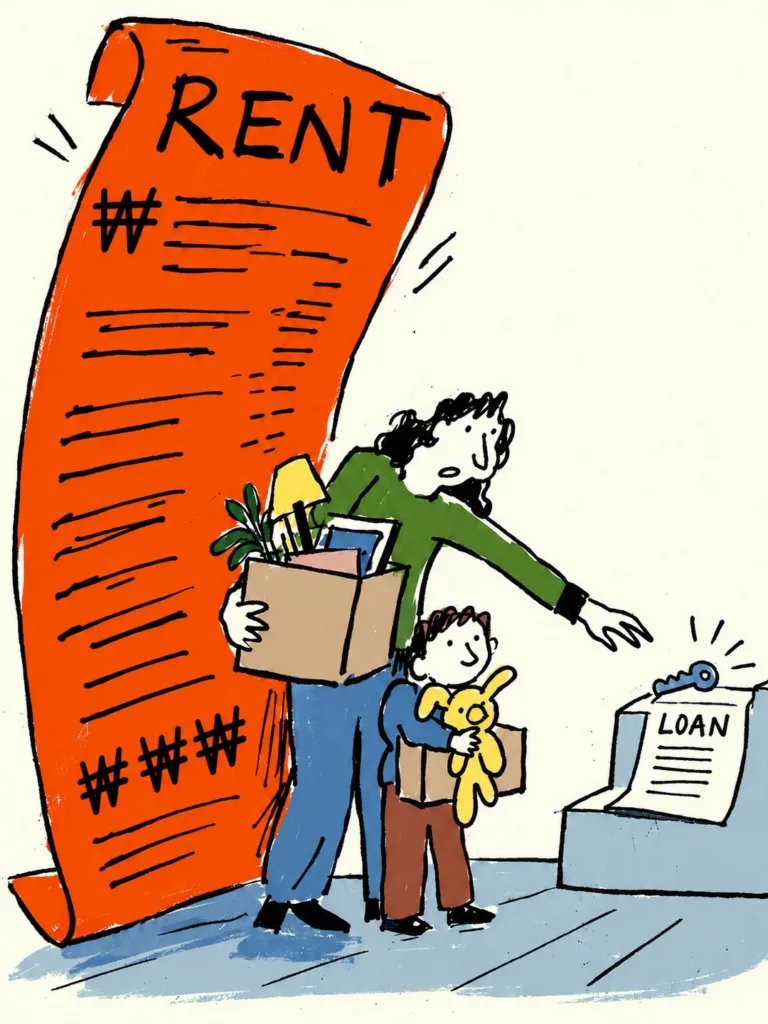
Jeonse is a Korean lease in which the tenant hands the landlord a large deposit, pays no monthly rent, and gets the deposit back on moving out. According to the Korea Real Estate Board (a state-backed real estate statistics agency), the average Seoul apartment jeonse deposit was 636.63 million won (about $471,000) in August 2026, up 82.68 million won (about $61,000), or 14.9%, from two years earlier, a record high.
A tenant who signed two years ago needs that much more to stay in a similar home. Borrowing it with a jeonse loan (average rate 4.35% a year in August) costs about 300,000 won (about $222) a month in interest alone. Over a two-year lease, that is about 7.19 million won (about $5,300) (BITPRESS calculation).
The average jeonse deposit (636.63 million won) is higher than even the top price of a home at or under 600 million won. This data alone can't show that tenants bought those homes, but Park says many people end up buying because there are no jeonse listings.
- Why homes under 600 million won, and why did pricier homes' share of sales shrink?
Start with loan limits. Under the Oct. 15 measures (lending rules announced on Oct. 15, 2025), mortgage caps in the Seoul metropolitan area were set at 600 million won for homes at or under 1.5 billion won, 400 million won above 1.5 billion won, and 200 million won above 2.5 billion won.
Over the same periods, the share of sales for homes above 1.5 billion won up to 2.5 billion won fell from 18.4% to 15.3%, and above 2.5 billion won from 8.3% to 5.8%. Shares always add up to 100%, so what pricey homes lose, other price ranges gain. It is like a pizza: if the big slices get smaller, the other slices take up more of the pie. Still, this data can't show that the loan caps caused the drop.
Taxes use a different cutoff. The tax reform plan announced on Aug. 3 would raise the property holding tax (a tax paid every year while you own a home) on homes worth 3 billion won (about $2.22 million) or more, so it does not directly overlap the 1.5-2.5 billion won group.
Prices also split. In the Korea Real Estate Board's weekly survey as of September 28, Gangnam-gu fell 0.56% and Seocho-gu 0.33%, while Seodaemun-gu rose 0.41% and Nowon-gu 0.34% (four districts as examples). This overlaps with the period when the share of homes at or under 600 million won grew, but the cause can't be known.
- BITPRESS Insight
For a Seoul tenant without a home whose lease is ending soon, rate news is only half the story. Rising rates added about 48,000 won a month to the payment of someone buying a 600 million won home, but a tenant who borrows to cover the higher average deposit at renewal pays about 300,000 won a month in interest alone. The two fall on different people over different periods, so they can't be compared directly. Still, it means that choosing to wait until rates fall also costs money every month.
That does not mean buying is the better deal. A buyer must pay the full roughly 1.24 million won every month, principal as well as interest, and bears the cost if rates rise further or the loss if home prices fall.
So there is one test. Between the extra monthly cost of keeping your jeonse and the full monthly loan payment if you buy, which can your paycheck carry?
Sources
https://www.seoul.co.kr/news/economy/estate/2026/10/06/20261006032002
https://m.inews24.com/v/2010449
https://biz.sbs.co.kr/article/20000337490
https://www.seoul.co.kr/news/economy/estate/2026/09/27/20260927500076
https://www.newsis.com/view/NISX20251017_0003366514
https://www.hankookilbo.com/news/article/A2026080309440004011
Glossary
Mortgages — Money borrowed from a bank with a home pledged as collateral.
LTV — Loan-to-value ratio; at 40%, you can borrow up to 240 million won on a 600 million won home.
Equal monthly payments — A repayment method in which you pay the same amount every month for the whole loan term, covering principal and interest together.
Jeonse — A Korean lease in which the tenant hands the landlord a large deposit instead of monthly rent and gets it back when the lease ends.
Property holding tax — The tax paid every year while you own a home, combining property tax and comprehensive real estate tax.
BITPRESS articles are information to help your investment decisions, not a recommendation to buy or sell any stock or coin. Investment decisions and their results are your own responsibility.