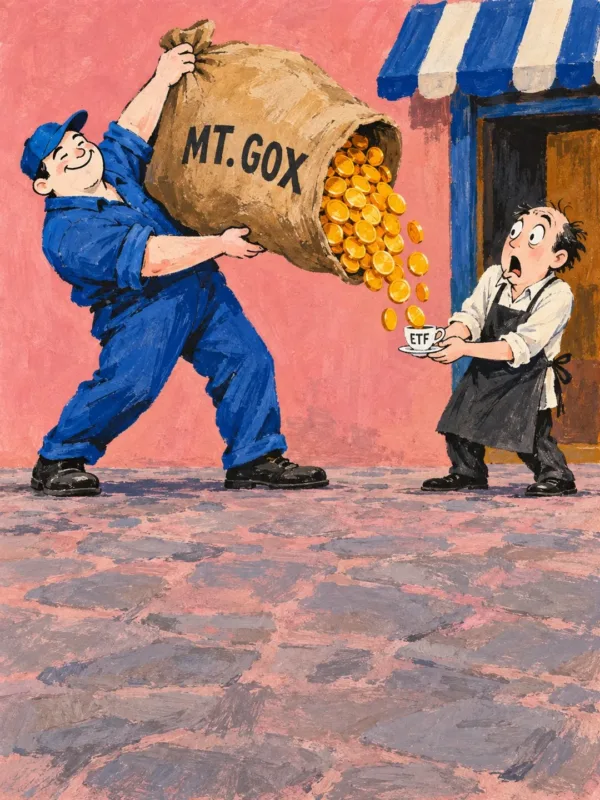
A venue for trading more than 60 U.S.-listed stocks, including Apple, Nvidia and Tesla, with stablecoins, even on weekends, has been filed for. OKXICE, a joint venture formed 50:50 by Intercontinental Exchange (ICE), the parent of the New York Stock Exchange, and crypto exchange OKX, notified the U.S. Securities and Exchange Commission (SEC) on Oct. 4 (per foreign media reports).
The phrase '24-hour stock trading' sounds new. But Korean investors already trade U.S. stocks almost all day on weekdays. When Korean brokerages reopened daytime trading in November 2025, they said investors could trade about 23 hours a day (varies by broker).
The key isn't the hours. What changes is weekends, and the money you buy stocks with and where you keep them.
- What did OKXICE file for?
What was filed is a Tokenized Securities Venue (TSV). A token stock turns the ownership of one share into a digital token on a blockchain (a public ledger anyone can check). Payment is in stablecoins (coins pegged at $1 each) USDC, USDG or USDT instead of dollars, and trading happens in Uniswap pools on XLayer, OKX's blockchain.
A pool is an automated market (AMM) that holds money and tokens deposited in advance and sets prices by how much of each is left. Think of it like a drink vending machine. The difference: a vending machine has a fixed price, but in a pool, when someone buys a lot and fewer tokens are left, the price goes up.
After a 30-day objection period following the filing, if requirements are met, it can open as early as early November. Meanwhile, AI chip company Cerebras filed an objection and pulled its stock from the list.
- Why is this kind of venue possible now?
Because on Sept. 17 the SEC introduced an 'innovation exemption.' Venues that meet its conditions can trade token stocks without registering as a stock exchange. It is a temporary, conditional exemption that lasts only five years.
It's like getting permission to run a food truck under set conditions, without a full restaurant license. The operator must be a U.S. company and must notify the company that issued the stock (the issuer) and give it a chance to object. Token stocks must give the same dividends and voting rights as the original shares, and must halt when the original exchange halts trading.
ICE also took part in a March investment round that valued OKX at $25 billion.
- How is this different from 23-hour weekday trading?
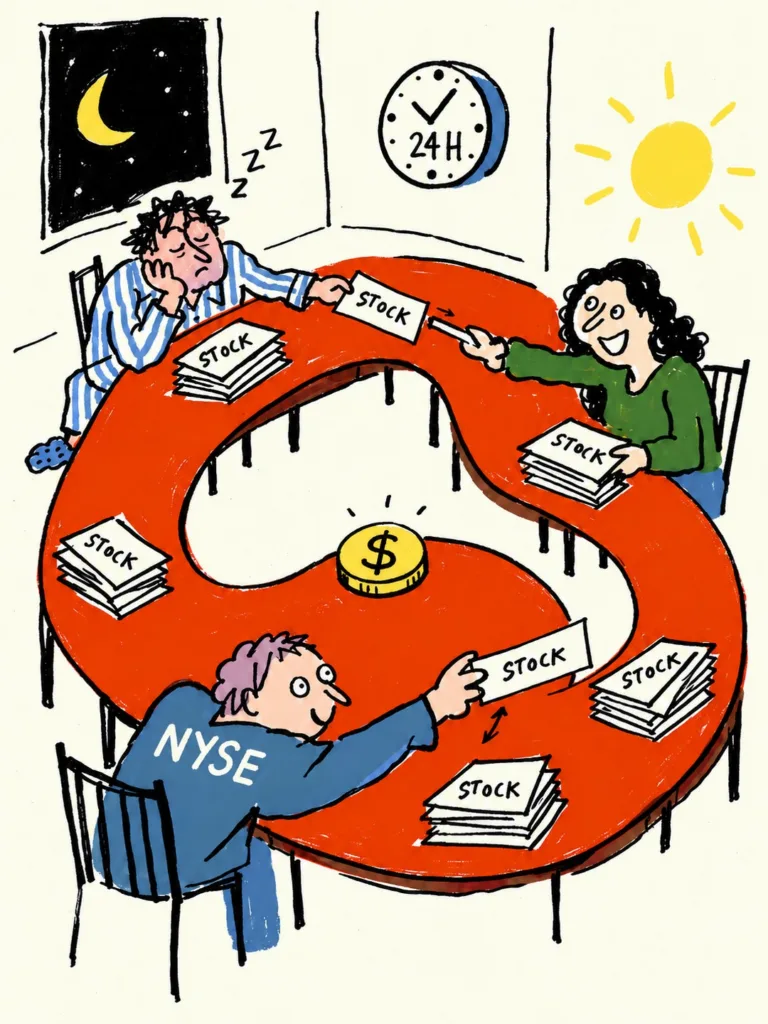
The first difference is the weekend. Today, if big news breaks after the market closes on Friday, investors must wait until the next trading day. This venue is designed to be open 24 hours a day, seven days a week.
It's like withdrawing cash from an ATM on a weekend when bank branches are closed. The difference: an ATM gives back exactly the amount you deposited, but on this venue the price depends on how much money and how many tokens are in the pool at that hour.
Second is payment and custody. Instant settlement and self-custody (keeping shares in your own wallet instead of a brokerage account) are built into the design. But every wallet needs an approval token from OKXICE (a soulbound token), and OKXICE also has the power to pause trading.
- How much can trade on this venue?
Volume has a cap. For large stocks (such as S&P 500 and Russell 1000 constituents), one venue can handle only up to 75 stocks, and daily volume is limited to 0.25% of the original stock's average daily volume over the prior month.
For a stock that trades 100 million shares a day on average, this venue could trade up to 250,000 shares a day (BITPRESS hypothetical calculation). Put simply, it's a small side door next to the main New York market. BITPRESS's view is that on days when orders pile up, trades may be hard to fill or prices may jump sharply.
Korean investors' holdings of U.S. stocks stood at $197.48 billion as of Sept. 1-21. But public reports don't say whether non-U.S. retail investors can use this venue.
- Where does money move through this venue?
To buy stocks on this venue, you first need stablecoins. Think of it like dollars you exchanged before a trip and spend right away abroad. Stablecoins could expand from money parked briefly before buying crypto to money used to buy stocks. Their total size was about $270 billion as of an Oct. 4 report.
ICE could gain a channel connecting crypto investors' money to U.S. stocks, and OKX a channel to handle token stocks inside the U.S. Nasdaq and the London Stock Exchange are also preparing for 24-hour trading.
- Why did Korean daytime trading stop for more than a year?
Blue Ocean, a U.S. alternative trading system (a private venue outside the official exchanges) that took U.S. stock orders during Korean daytime hours, canceled trades all at once in August 2024. Korean brokerages' daytime trading stayed halted for more than a year before reopening on the condition of using several venues.
Relying on a single venue means the path is cut off when it stops. This venue, too, can be paused by OKXICE, and orders are taken not by people but by a pool. At times when little money is in the pool, such as weekends, it may be hard to buy at the price you want.
- BITPRESS Insight
What this venue changes is less the trading hours than the kind of money used to buy stocks. Until now, U.S. stocks were bought with dollars and held in brokerage accounts. On OKXICE, they are bought with stablecoins and kept in your own wallet approved by the operator.
So the first to find it easy to use are crypto investors who already hold stablecoins. For Korean retail investors in overseas stocks, nothing changes right away.
When big news on a weekend makes you want to buy right away, there's one test. Not whether the venue's door is open, but whether enough money has gathered at that hour to take your order.
Sources
https://www.ledgerinsights.com/ice-okx-venture-plans-trading-of-tokenized-us-stocks-via-uniswap-pools/
https://financefeeds.com/okx-and-nyse-parent-ice-file-to-launch-tokenized-stock-platform-in-the-us/
https://www.marketsmedia.com/okxice-files-to-launch-tokenized-securities-venue/
https://en.bloomingbit.io/feed/news/121584
https://www.skadden.com/insights/publications/2026/09/sec-innovation-exemption-establishes
https://www.coindesk.com/policy/2026/09/17/sec-rolls-out-long-awaited-innovation-exemption-for-tokenized-securities-venues
https://www.fntimes.com/html/view.php?ud=20251104132113265179ad43907_18
https://biz.newdaily.co.kr/site/data/html/2026/09/25/2026092500012.html
https://finance.yahoo.com/markets/crypto/articles/bitcoin-enters-october-4-problems-151855980.html
https://kbthink.com/investment/fx/daily/261002.html
Glossary
Tokenized stock — Ownership of one share turned into a digital token on a blockchain, so it can be held in a wallet and sent like a coin.
Stablecoin — A coin designed to hold a value of $1 each; examples include USDC, USDT and USDG.
Automated market (AMM) — A market that does not match orders between people, but sets prices automatically based on how much money and how many tokens were deposited in advance.
Innovation exemption — A temporary, conditional exemption the SEC introduced on Sept. 17; tokenized stock venues that meet its conditions can operate for five years without registering as a stock exchange.
Alternative trading system — A private venue outside the official stock exchanges that collects stock orders and matches trades.
BITPRESS articles are information to help your investment decisions, not a recommendation to buy or sell any stock or coin. Investment decisions and their results are your own responsibility.