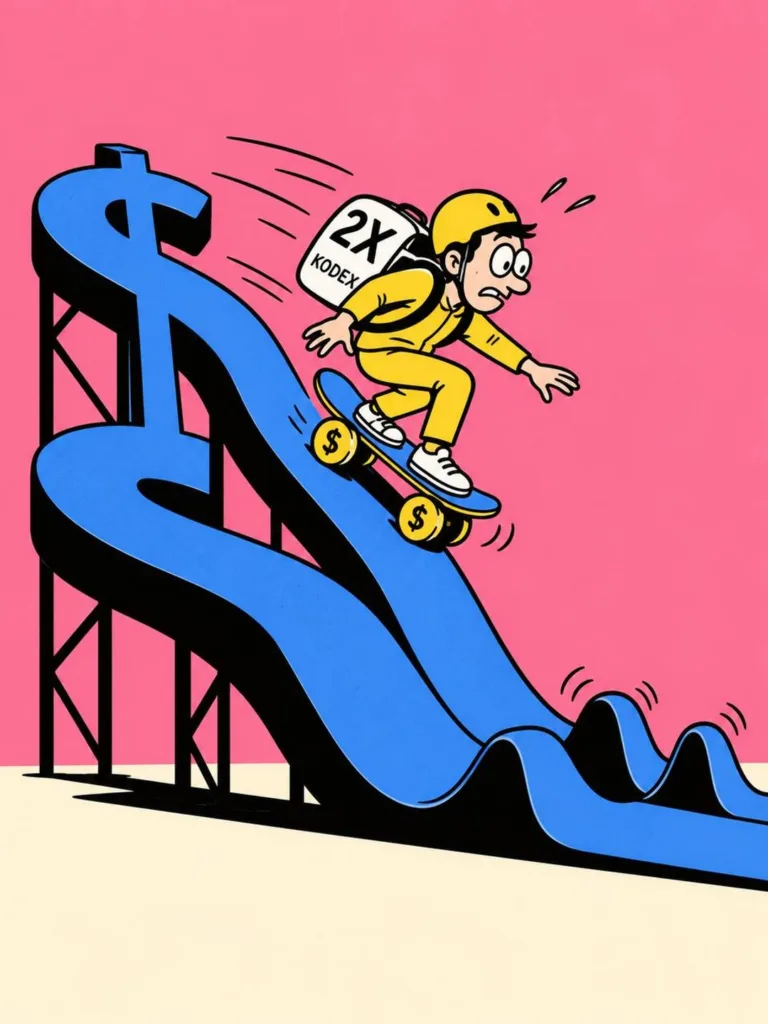
From June 1 to Sept. 30, 2026, the three best-performing exchange-traded funds (ETFs, funds that trade on an exchange like a stock) listed in Korea were all 2x inverse dollar ETFs, known among Korean investors as "gopbus." By the Korea Exchange's tally, KODEX US Dollar Futures Inverse 2X rose 22.76%, followed by TIGER and KIWOOM products with the same structure at 22.49% and 22.39%.
"Gopbus" combines the Korean words for "multiply" and "inverse" (a product that moves opposite to an index). It is a product built to rise by twice the percentage its index falls on a given day. So these results are often read as "it made twice what the dollar lost."
But over the same period, the US Dollar Futures Index these products track fell 9.91%. A simple 2x would mean 19.8%, yet the top product made about 2.9 percentage points more. The key is that these ETFs reset to twice the return of each single day, every day, rather than twice the return over the whole period.
- What does a 2x inverse dollar ETF track?
All three products track the daily change in the US Dollar Futures Index, traded on the Korea Exchange, at -2 times. A futures contract is an agreement made in advance to buy or sell at a set price on a set future date, and this index is built from dollar futures prices.
The index fell from 1,685.61 on June 1, 2026, to 1,518.50 on Sept. 30. Over the same period, the won-dollar exchange rate also dropped from KRW 1,504.3 to KRW 1,352.8 per dollar, based on the daytime closing rate in the Seoul foreign exchange market. Put simply, while the dollar futures index fell about 10%, the 2x inverse ETFs rose more than 20%.
- Why does a steady fall earn more than 2x?
A two-day example calculated by BITPRESS makes it easy. If the index falls 5% a day for two days, it drops 9.75% over the two days. A simple 2x would mean the 2x inverse ETF should rise 19.5%.
But the ETF rises 10% on the first day, turning KRW 100 into KRW 110, and on the next day another 10% is added to the larger KRW 110, making KRW 121. The two-day return is 21%, 1.5 percentage points more than a simple 2x. This is compounding: gains build on money that has already grown.
If the index had fallen by the same amount every trading day this period to end down 9.91%, the ETF's gain would come to about 23.2% by calculation (before fees and other costs). Put simply, the straighter the dollar's decline, the more a 2x inverse ETF earns beyond "2x."
- The same compounding eats money when prices swing
The actual gain of the No. 1 product, 22.76%, is about 0.4 percentage points below the 23.2% from assuming a steady fall. Possible causes include mid-period rebounds, management fees (fees the fund manager takes from fund assets) and gaps between market price and fund value. Without daily index data, it is not possible to say how much each factor contributed.
When prices keep swinging up and down, compounding works toward losses. In a BITPRESS example, if the index falls 5% one day and rises 5% the next, it ends down 0.25%, nearly back where it started. The 2x inverse ETF gains 10% on the first day and loses 10% on the next, leaving a 1% loss.
Samsung Securities' investment guide also explains that leveraged and inverse products can lose more when the market moves sideways (drifts without a clear direction) or keeps rising and falling. The concept comes from Samsung Securities; example figures like 5%, 9.75% and 21% are BITPRESS calculations. It means the 2x inverse ETF account shrinks even when the index returns near its starting point.
- The won-dollar rate stopped falling after Sept. 9
The won-dollar rate closed at KRW 1,336.10 per dollar on Sept. 9, 2026, its lowest since Oct. 4, 2024, based on Seoul's regular session. According to reports, high oil prices, rising US Treasury yields and a Bank of Japan rate hike then combined to push the dollar back up, and the rate went as high as KRW 1,383.3 on Sept. 18.
After that, the exchange rate on Sept. 30 was KRW 1,352.8, about 1.2% above Sept. 9, and on Oct. 2 it was KRW 1,358.4 (Seoul close), about 1.7% above. KODEX’s dollar 2x inverse ETF rose to an intraday high of KRW 5,705 on Sept. 9 and fell to KRW 5,575 on Oct. 2, about 2.3% below that intraday high. In short, the June–September slide did not continue after Sept. 9.
However, this picture is based on prices at only a few dates, so it does not show how the rate moved up and down each day in between.
- October forecasts split between upward pressure and a cap on gains
According to reports, one foreign-exchange expert said upward pressure on the exchange rate (the force pushing it up) has the upper hand, driven by a stronger global dollar and foreign net selling of Korean stocks (selling more than they bought). If geopolitical risks such as the stalled US–Iran talks add on, that upward pressure could grow.
Banks' October forecast ranges are wide. Hana Bank gave KRW 1,345–1,370 and said dollar supply from strong exports could cap the upper end. KB Kookmin Bank gave KRW 1,330–1,400 and cited strong semiconductor exports and a large current account surplus (a state in which Korea earns more from abroad through goods and services trade than it spends) as limits on how far the won could weaken.
The low end of Kookmin Bank's range is below the Sept. 9 low, and the high end is above the Sept. 18 high. If the rate just swings up and down within this range with no clear direction, that works against 2x inverse ETFs, as the earlier calculation shows; if the exchange rate and the dollar futures index fall, the ETFs gain. Which way it goes is still only a forecast.
- BITPRESS Insight
The 2x inverse dollar ETF's 22.8% is not a number that came from "the dollar fell 10%" alone. The roughly 3 percentage points above a simple 2x suggest the index may have been on a mostly downward path over the four months. That is an inference worked backward from the end result, not from the daily path.
The same structure works in reverse when the direction turns or the swings drag on. That is why a 2x inverse ETF's report card records both how much the dollar fell and how straight it fell.
A 2x inverse ETF's return is not decided by getting the direction right alone. If the index returns to its starting point, a 2x product ends not at zero but at a loss.
Sources
https://www.newstong.co.kr/view3.aspx?seq=14724360
https://www.econovill.com/news/articleView.html?idxno=752691
https://www.news1.kr/finance/market-exr/6306275
https://kbthink.com/investment/fx/daily/261002.html
https://www.samsungpop.com/mbw/o2Info/contents.do?cmd=detail&boardId=2241&isEbd=Y
https://www.news1.kr/finance/general-stock/6309193
Glossary
Gopbus (2x inverse ETF) — A product built to rise by twice the percentage its index falls on a given day; the Korean nickname combines "multiply" and "inverse."
Inverse product — A product built to move in the opposite direction from the index it tracks.
US Dollar Futures Index — An index built from the prices of dollar futures traded on the Korea Exchange; it is the benchmark that 2x inverse dollar ETFs track.
Futures — An agreement made in advance to buy or sell at a set price on a set future date.
Compounding — Gains or losses building on money that has already grown or shrunk, so the result differs from a simple sum even at the same rates.
Won-dollar exchange rate — How many Korean won one US dollar costs. When the number falls, the dollar is weaker and the won is stronger.
KODEX, TIGER, KIWOOM — Brand names of ETFs listed in Korea. The three products in this story share the same structure: each tracks the daily change in the US Dollar Futures Index at -2 times.
BITPRESS articles are information to help your investment decisions, not a recommendation to buy or sell any stock or coin. Investment decisions and their results are your own responsibility.