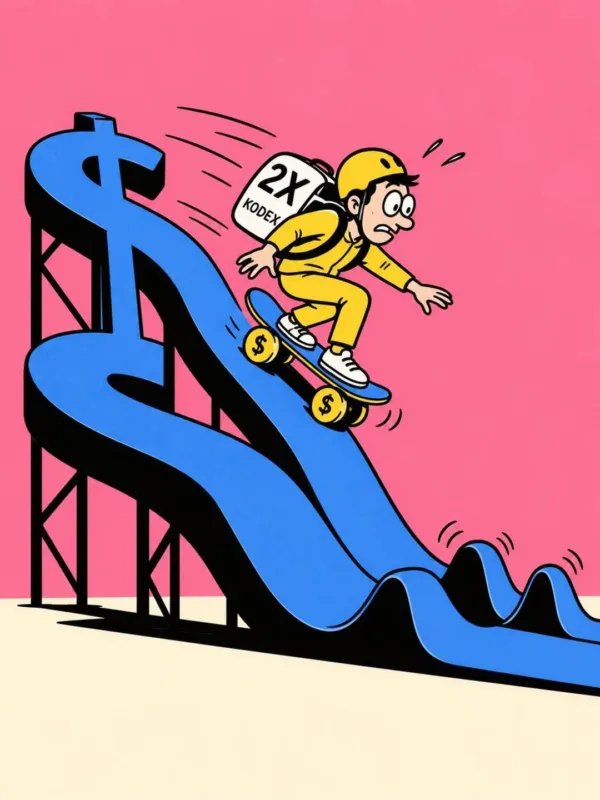
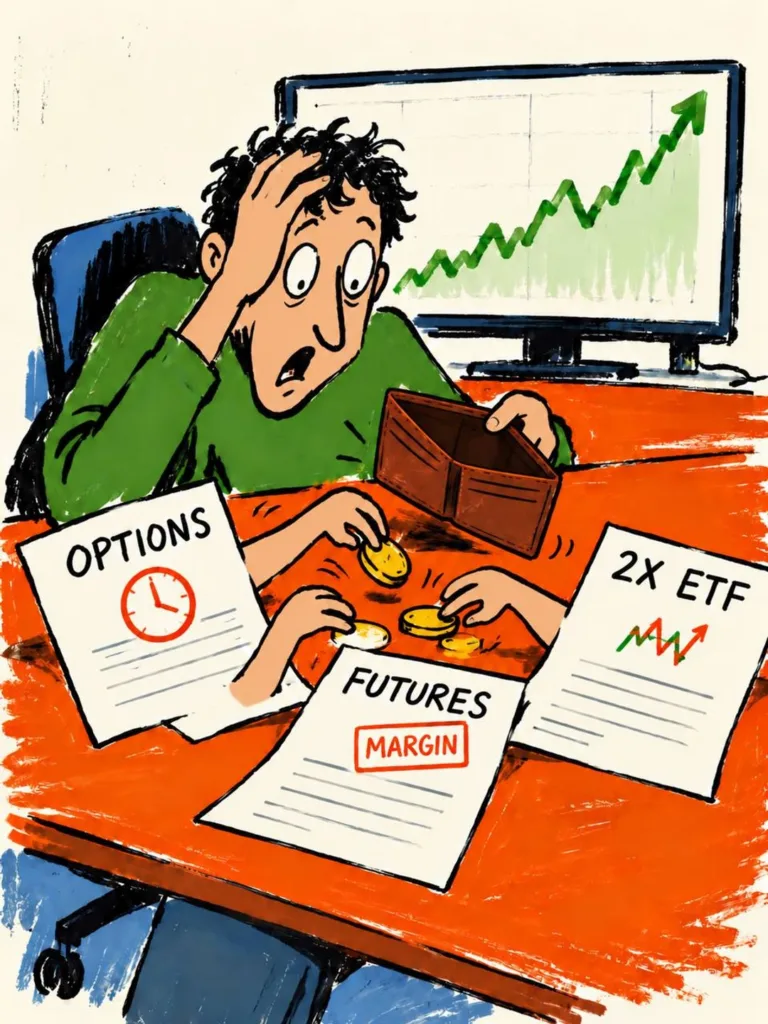
Leveraged ETFs, options and futures are sometimes lumped together as 'risky products.' On May 27, 2026, leveraged ETFs and similar products tracking a single stock, Samsung Electronics or SK hynix, also listed in Korea for the first time.
But the difference among the three is not only how much risk they carry. It is what you have to get right to make money. Even if you correctly expect a price to rise, your account can still show a loss. We ask the same question three times: "It went up in the end, so why is my account down?"
All numbers below are hypothetical examples made by BITPRESS, before fees and taxes.
- Options and futures are contracts; leverage is a method
Futures are a contract in which you agree now to buy or sell at a set price on a set future date (expiration). An option is a contract in which you pay money (the premium) for the right to buy (a call option) or the right to sell (a put option) at a set price (the strike price) until expiration.
Leverage is not a product name but a way of investing on a bigger scale with a small amount of your own money. It is like using a lever to lift a heavy rock with little effort. With futures you put up only part of the contract value, and with options you pay only a small premium to get an effect similar to a large trade. So options and futures also carry leverage, and the three are not completely separate products.
In this article, 'leverage' is narrowed to the leveraged ETF most readers know: a fund that tracks 2x the daily move of an index or a stock.
- Options: it rose, but not far enough or soon enough
It went up in the end, so why is my account down? With options, it is because the stock did not rise far enough, soon enough.
Say you pay KRW 500 for a call option that lets you buy a stock now trading at KRW 10,000 for KRW 10,000 at expiration. If the stock is at KRW 10,300 at expiration, it rose 3%, but the gain from using the right is KRW 300. Subtract the KRW 500 you paid and you lose KRW 200, or 40% of the money you put into the option.
A rising stock and a profit on the option are not the same thing. To break even, the stock must be at KRW 10,500 at expiration, a 5% rise. If it climbs to KRW 11,000, the KRW 1,000 gain minus the KRW 500 paid doubles the money put into the option, a 100% gain.
Timing matters too. If the stock is below KRW 10,000 at expiration, you give up the right and lose the KRW 500 you paid. However high the stock goes after that, an expired option is worth nothing. Put simply, an option is a bet not on 'it will rise' but on 'it will rise by at least this much, by this date.'
- Futures: it rose in the end, but you were pushed out first
It went up in the end, so why is my account down? With futures, it is because the price fell first and pushed you out before it rose.
With futures, you don't pay the full contract value. You put up part of it as margin (a good-faith deposit showing you will honor the contract). Say you buy KRW 10 million worth of futures, put up KRW 2 million in margin, and must keep at least KRW 1.5 million in the account (the maintenance margin). The 20% margin and 15% maintenance margin are assumptions for illustration; actual rates vary by product and over time.
If the price falls 6%, you lose KRW 600,000 and the account is left with KRW 1.4 million, below the maintenance margin. The price fell 6%, but your deposit shrank 30%. The leverage of a big contract on little money worked just as hard on the losing side.
Then comes a demand to add money by a deadline (a margin call). If you can't, the broker closes the contract for you (forced liquidation). Assuming it is closed at that point, the KRW 600,000 loss becomes final.
Even if the price then rises 10% above where it started, this investor gets nothing. Had they held on, they would have made KRW 1 million, 50% of the deposit. With futures, besides the direction, you need enough cash to hold on through a dip along the way.
- Leveraged ETFs: 2x is a promise for one day, not the whole period
It went up in the end, so why is my account down? With leveraged ETFs, it is because the path of ups and downs changes the return.
A leveraged ETF tracks 2x the daily move, not 2x the move over your whole holding period. Each day's result becomes the next day's starting amount, which then grows or shrinks by 2x again. This is the compounding effect. So if you hold for several days, the result can differ from '2x the period's return.'
Say an index falls 10% on the first day, from 100 to 90, then rises 12.2% the next day to 101. Over two days, the index rose 1%. A KRW 1 million position in the ETF drops 20% to KRW 800,000 on the first day, then rises 24.4% to about KRW 996,000. The index went up, yet the ETF lost 0.4%.
If the index had come back to exactly 100, the loss would be about 2.2%.
On the other hand, a steady move in one direction lets compounding help. If the index rises 10% two days in a row, the index gains 21% and the ETF 44%, more than a simple 2x (42%). So it is not true that holding long always means a loss. It can work against you when prices swing up and down repeatedly.
Put simply, with a leveraged ETF, not just where the price ends up but the path it took to get there changes your return.
- BITPRESS Insight
What investors need to get right is not just up or down. For options it is the size and timing of the move, for futures it is cash to withstand losses along the way, and for leveraged ETFs it is the path the price takes each day, all the way through.
So lumping the three together as simply 'risky' misses the difference that matters. Even with the same expectation of a rise, what you have to get right depends on which product you chose.
Before buying, look less at the expected return and more at this: under what conditions do I lose money even if I'm right?
Sources
https://www.kbsec.com/go.able?linkcd=s070400202000
http://money2.daishin.com/html/WTS/Customer/GuideUser/DW05_CUS_INF_012.html
https://m.koreainvestment.com/main/customer/tradetransfer/_static/TF04da050000.jsp
https://kbthink.com/dictionary/view.html?dictId=KED-00009936
https://economist.co.kr/article/view/ecn202605230002
https://www.kcie.or.kr/mobile/guide/2/25/web_view?series_idx=&content_idx=1043
https://www.samsungpop.com/mbw/o2Info/contents.do?cmd=detail&boardId=2241&isEbd=Y
Glossary
Call options — The right to buy an asset at a set price (the strike price) until a set date.
Premium — The price paid for an option; if you give up the right, you lose this amount.
Margin — A deposit of part of the contract value, put up to show you will honor a contract such as futures.
Forced liquidation — When you can't meet a demand to add money because your margin ran short (a margin call), the broker closes your contract for you.
Leveraged ETF — A fund built to track 2x the daily move of an index or stock; it matches 2x each day, not over the whole period.
Futures — A contract to buy or sell something at a set price on a set future date. You put up only part of the value as margin, so gains and losses are large compared with the money you put in.
BITPRESS articles are information to help your investment decisions, not a recommendation to buy or sell any stock or coin. Investment decisions and their results are your own responsibility.