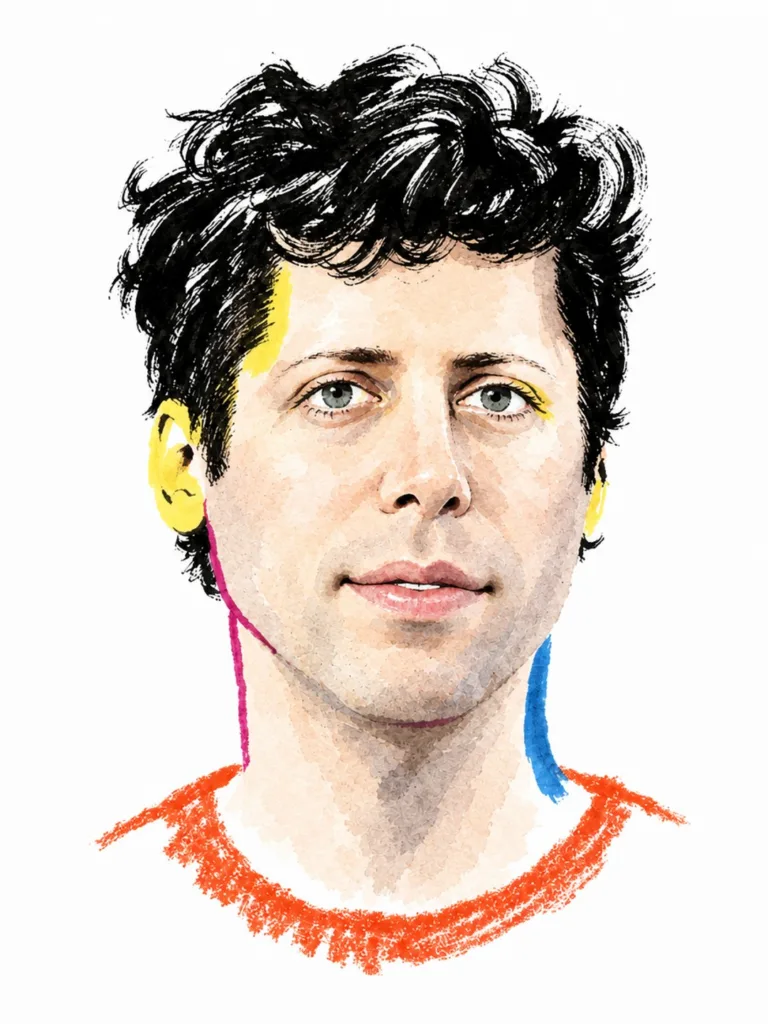
In February 2025, Sam Altman, CEO of OpenAI (the company behind ChatGPT), posted a short essay on his blog called "Three Observations." It is about how AGI (artificial general intelligence, AI that can solve hard problems across many fields on its own, like a person) will change the economy.
The essay is usually read as optimism: AI will make everything cheap. But 19 months later, when you check the numbers, the sentence investors should underline is a different one: "The price of many goods will eventually fall dramatically, but the price of luxury goods and inherently limited resources like land may rise even more dramatically."
- Altman's three observations
First, an AI model's intelligence roughly tracks the "log" of the resources put into it (computing power and data). Every 10x more resources buys one more step up. Think of grades that rise with the number of digits in your study hours, not the hours themselves. The difference is that with AI, putting in money produces those steps almost exactly as predicted.
Second, the cost of using a given level of AI falls about 10x every 12 months. Altman wrote that from GPT-4, released in March 2023, to GPT-4o, released in May 2024, the price per token (the text fragments AI reads and writes) fell about 150x. That is far steeper than Moore's law, under which chip performance doubles every 18 months.
Third, the economic value created by each step up in intelligence grows far faster than the steps themselves. Put simply, each step costs 10x more money, but it is still worth paying, so the investment does not stop.
- 19 months later, the prediction that AI gets cheaper held up
Outside data confirm the falling cost. Venture firm a16z found that AI of the same performance gets 10x cheaper every year (November 2024), and research group Epoch AI found prices falling by 9x to 900x a year depending on the performance level (March 2025).
The "AI agents" (AI that takes on work in place of a person) that Altman promised have arrived too. Codex, the coding agent OpenAI launched in May 2025, passed 2 million weekly users in March 2026. OpenAI's annualized revenue topped $40 billion in August 2026, about double its level at the end of 2025.
- But some things got more expensive
While AI got cheaper, the inputs needed to build it started running short. SK hynix (the No. 1 maker of HBM, the high-performance memory used in AI) wrote in its U.S. listing documents in July 2026 that "in recent quarters, demand for our products has exceeded our available supply." Its HBM market share was 56.4% (Q1 2026).
Power is the same. At PJM, the grid operator for the eastern U.S., the capacity auction price for 2027-28 hit the $333.44 per megawatt-day cap, a record high, and the rise in forecast demand was "almost entirely driven by data centers." The International Energy Agency (IEA) expects data-center electricity use to grow from 415 terawatt-hours in 2024 to 945 terawatt-hours in 2030, about what all of Japan uses.
Put simply, the cost of using AI once keeps falling, but the chips and power that run AI have become things you have to wait in line to buy.
- The biggest buyer is Altman himself
In January 2025, OpenAI announced Stargate with SoftBank and Oracle, a data-center plan to spend up to $500 billion by 2029. In November 2025, Altman said he was looking at about $1.4 trillion of computing commitments over the next eight years. The money OpenAI spends is money spent on chips, power and land.
The four Big Tech companies (Amazon, Alphabet, Microsoft and Meta) expect $720 billion to $745 billion of capital spending in 2026, about double 2025. The race to make intelligence cheap is making scarce inputs expensive. Both sentences Altman wrote are coming true at the same time.
- The Gold Rush went the same way
During the 19th-century U.S. Gold Rush, Levi Strauss did not dig for gold. He moved to San Francisco and opened a dry goods business supplying the small general stores of the American West, and in 1873 he received a patent for riveted work pants for working men (later known as blue jeans). The more people hunted for gold, the faster picks and pants sold.
This time is different in one way. Stargate's seven sites add up to more than 9 gigawatts of planned capacity, but in April 2026 only about 0.3 gigawatts was actually running, in Abilene, Texas. According to Reuters, OpenAI in February 2026 set a target of about $600 billion in computing spending through 2030, lower than the $1.4 trillion in commitments. Scarce inputs rise in price only when plans turn into real construction and orders.
- What it means for investors in Korean stocks
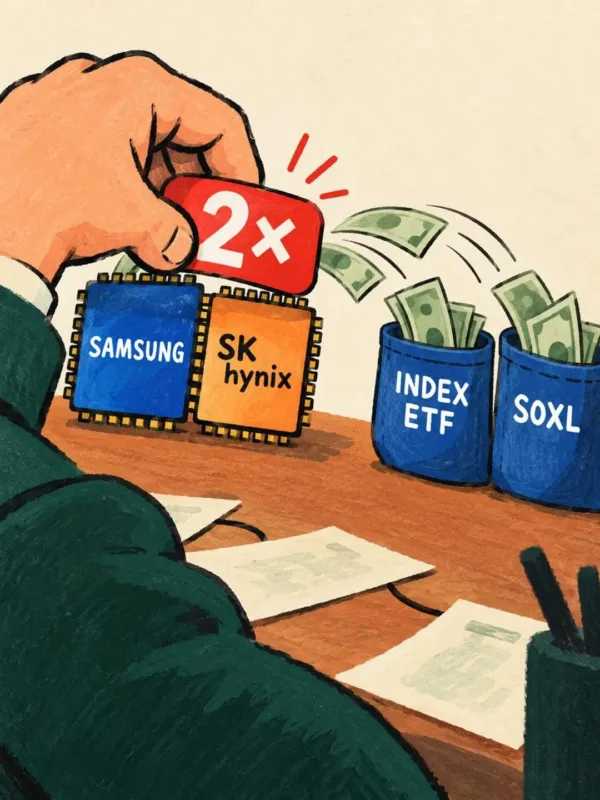
In October 2025, Samsung Electronics and SK hynix signed letters of intent with OpenAI to supply memory for Stargate, and according to industry reports the target is up to 900,000 DRAM wafers (the discs chips are made on) a month. The sentence in Altman's essay that matters most for the Korean market is not "intelligence gets cheap" but "limited things get expensive."
SK hynix's revenue in Q1 2026 was KRW 52.576 trillion (about $34.5 billion), more than half of its full-year 2025 revenue of KRW 97.147 trillion earned in a single quarter. But that number rests on the assumption that AI companies' commitments turn into real orders.
- BITPRESS Insight
Altman's essay presents AGI as a gift to humanity. He wrote that by 2035 anyone should be able to use the intellectual capacity of everyone in 2025, and floated the idea of giving everyone a "compute budget." Consumers enjoy the cheaper intelligence. The money made in building that gift flows to what is scarce: chips, power and land.
So investing in the AGI era starts not with "what does AI make cheap?" but with "what runs short when you build AI?" What gets cheaper keeps falling in price through competition. What runs short has buyers lining up and bidding the price higher.
But OpenAI, at the front of that line, has already lowered its target once. The value of scarce things comes from commitments, not technology. For investors riding scarce inputs, what matters is not how smart AI gets, but whether those commitments turn into real purchase orders.
Sources
https://blog.samaltman.com/three-observations
https://insideaipolicy.com/ai-wire/altman-offers-ai-observations-public-policy-needs-eve-paris-summit
https://a16z.com/llmflation-llm-inference-cost/
https://epoch.ai/data-insights/llm-inference-price-trends
https://en.wikipedia.org/wiki/OpenAI_Codex_(AI_agent)
https://finance.yahoo.com/technology/ai/articles/openai-revenue-run-rate-tops-224009196.html
https://www.sec.gov/Archives/edgar/data/0002120882/000119312526299963/d32785d424b4.htm
https://www.utilitydive.com/news/pjm-interconnection-capacity-auction-data-center/808264/
https://www.scientificamerican.com/article/ai-will-drive-doubling-of-data-center-energy-demand-by-2030/
https://en.wikipedia.org/wiki/Stargate_LLC
https://techcrunch.com/2025/11/06/sam-altman-says-openai-has-20b-arr-and-about-1-4-trillion-in-data-center-commitments/
https://mlq.ai/news/big-techs-2026-capex-range-reaches-720-billion-to-745-billion/
https://sherwood.news/tech/alphabet-amazon-microsoft-meta-plan-more-than-700-billion-on-capex-this-year/
https://epoch.ai/publications/openai-stargate-where-the-us-sites-stand
https://techstartups.com/2026/02/23/openai-expects-600b-compute-spend-by-2030-as-company-eyes-1-trillion-ipo/
https://www.astutegroup.com/news/general/samsung-and-sk-hynix-to-supply-900000-dram-wafers-monthly-for-openais-500-billion-stargate-project/
https://www.levistrauss.com/levis-history/
Glossary
AGI (artificial general intelligence) — AI that can solve hard problems across many fields on its own, like a person, rather than one specific task. There is no settled definition yet.
Token — The text fragments AI splits writing into when it reads and writes; the unit AI usage is priced in.
HBM — High-performance memory attached next to AI chips to move data very fast.
Stargate — A large AI data-center plan OpenAI is building in the U.S. with SoftBank, Oracle and others.
Capital expenditure — Money a company spends on long-lived assets such as factories, data centers and equipment.
BITPRESS articles are information to help your investment decisions, not a recommendation to buy or sell any stock or coin. Investment decisions and their results are your own responsibility.