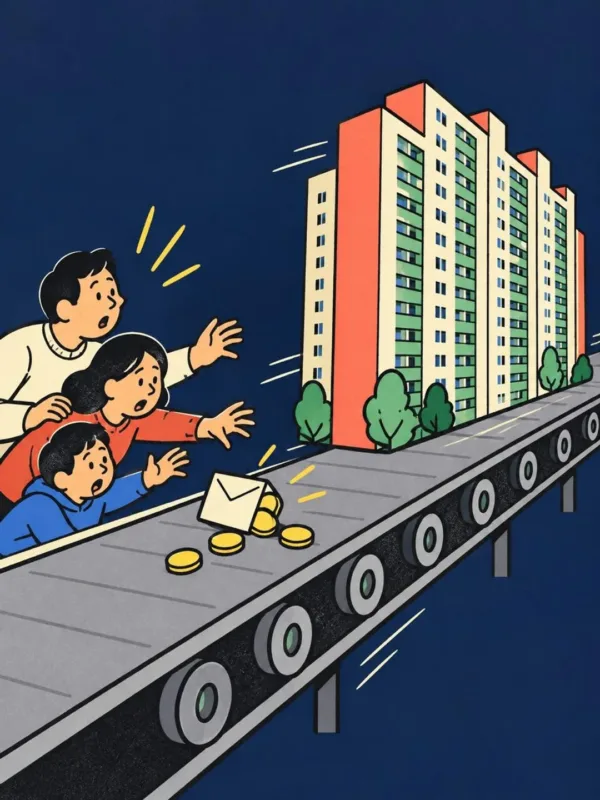

Seoul apartment prices have risen for 85 straight weeks. In the Korea Real Estate Board's survey for the third week of September, Seoul apartment prices rose 0.13% from the week before, matching the all-time record streak of 85 weeks set in 2020-2022. Yet that same week, Gangnam district fell 0.42% and Seocho 0.37%. Both have now fallen for seven weeks in a row.
Two directions are colliding inside the single sentence 'Seoul home prices keep rising.' What is lifting Seoul as a whole is not Gangnam but mid- and lower-priced districts such as Seongbuk, Seodaemun and Dongdaemun. Following why Gangnam is falling while outer areas rise reveals the character of this rally.
- Gangnam falls, the north side rises
In the third week of September, Seodaemun rose 0.44%, Dongdaemun and Seongbuk 0.39%, and Nowon 0.37%. The 14 districts north of the Han River averaged 0.28%, far above the 0.01% average of the 11 districts south of it. With Songpa (-0.14%), all three Gangnam-area districts fell together for a third straight week.
The gap is even wider for the year so far. Seongbuk is up 14.46%, Seodaemun 11.94% and Gangseo 11.73%, while Gangnam is up only 0.30% and Seocho 1.70%.
- Regulation and taxes are cited behind Gangnam's decline
The market sees loan restrictions, land transaction permits (zones where buyers must actually move in) and tax changes tangling with short supply and steady real demand, producing a split in which Gangnam falls and outer areas rise. Some analysts say the tax reform plan is weighing on the three Gangnam-area districts.
The comprehensive real estate tax (an annual tax on expensive homes) overhaul, which the government planned to send to the National Assembly with its tax plan before Sept. 3, would set the one-home owner threshold at an official assessed value above KRW 1.4 billion (about KRW 2 billion in market value) and keep the basic deduction for homes the owner does not live in lower, at KRW 900 million. If passed, the more expensive a home is and the less the owner lives in it, the heavier the tax.
- A jeonse crunch is cited behind the outer districts' rise
A shortage of jeonse (Korea's lump-sum deposit lease) and monthly-rent listings is cited as the cause of rising prices in outer Seoul. On Sept. 22 there were 20,298 jeonse listings for Seoul apartments, down 13.3% from 23,390 a year earlier. By KB Real Estate's count, the average Seoul apartment jeonse deposit in August was KRW 711.78 million, up 9.2% in a year.
Analysts say that as jeonse costs rose and homes became harder to rent, more people moved to buy outer-district apartments, where the price bar is relatively lower. Nam Hyuk-woo, a real estate researcher at Woori Bank, said the districts leading Seoul prices since October last year have been lower-priced ones, not Gangnam, driven by purchase demand from the shortage of rental listings.
Carrying a jeonse with a loan has also become harder. Major banks' two-year fixed jeonse loan rates were 4.01-6.61% a year at the end of August. Borrow KRW 200 million at 6% and the interest alone is about KRW 1 million a month. Professor Kwon Dae-jung of Hansung University said that when jeonse prices and rates are both high, jeonse demand may shift to cheaper places such as outer Seoul or Gyeonggi, or to monthly rent.
- Supply is shrinking and rates are rising
Supply is also short. Seoul's scheduled move-ins of new apartments this year are 27,158 units, 26.9% fewer than last year's 37,103. From next year through 2029, scheduled move-ins are expected to average about 10,322 units a year.
Meanwhile, the cost of borrowing has risen. The Bank of Korea raised its benchmark rate to 3% in August. The five major banks' fixed mortgage rates were 4.89-6.89% a year on Sept. 22, with the low end up nearly 1 percentage point from 3.93-6.23% at the end of last year.
- The reverse order of the last record run
Over these 85 weeks, Seoul apartment prices have risen about 17.49% in total, far more than the 7.71% of the previous longest rally. When that earlier streak began in June 2020, the benchmark rate was 0.5%. Rates are higher now, yet this time limited supply and demand concentrated in Seoul are cited as the drivers.
The order of the turn is different too. In the previous record rally, outer areas fell first and then Seoul as a whole turned down. This time, signs of a correction are appearing first in the three Gangnam-area districts while outer areas keep rising. The pace of gains has also slowed for four straight weeks, from 0.29% in the fourth week of August to 0.22%, 0.20%, 0.16% and 0.13%.
- BITPRESS Insight
'Seoul home prices are rising' is no longer a single story. Expensive homes weighed down by loan and tax rules are falling, while mid- and lower-priced homes that tenants squeezed by the jeonse crunch are turning to are rising. Gangnam, where regulation is cited, and outer areas, where the rental shortage is cited, are being pushed by different forces.
So interest rates may not have the same effect across Seoul. Rates and regulation hit expensive homes that are hard to buy without a loan right away, but demand from people who can't find a jeonse and switch to buying may not stop until the listing shortage eases.
The rule of thumb fits in one line. The direction of Seoul home prices shows up first not in the average gain but in whether jeonse listings start to rise again.
Sources
https://www.etnews.com/20260924000046
https://www.mt.co.kr/estate/2026/09/24/2026092215551116712
https://www.newsis.com/view/NISX20260908_0003781223
https://www.etoday.co.kr/news/view/2619488
Glossary
Decoupling — When two things that used to move together start moving in different directions.
Land transaction permit system — A rule requiring permission to buy a home in designated zones, and requiring the buyer to actually live in it.
Comprehensive real estate tax — An annual tax on people who own homes whose official assessed value exceeds a set threshold.
Official assessed value — The home value the government sets for tax purposes, usually below the actual market price.
Fixed-rate mortgage — A home-secured loan whose interest rate stays the same for a set period.
BITPRESS articles are information to help your investment decisions, not a recommendation to buy or sell any stock or coin. Investment decisions and their results are your own responsibility.