On Sept. 18, foreigners turned net buyers of KOSPI stocks for the first time in eight trading days. The KOSPI rose 2.66% that day to close at 6,894.23. Because the US Federal Reserve (the Fed, the US central bank) had raised rates for the first time in over three years two days earlier, it was easy to read the scene as ‘foreigners came back despite the rate hike.’
But a look at the stock-by-stock trading data tells a different story. Foreign buying that day was concentrated in a single stock, SK hynix, and for the week as a whole foreigners actually sold KRW 8.7835 trillion of KOSPI stocks. On the same day, foreigners sold Samsung Electronics. We look step by step at why it was SK hynix of all stocks, and whether this can be called a foreign return.
- Right after the rate hike, foreigners sold first
On Sept. 16 (US time), the Fed raised its benchmark rate by 0.25 percentage points to 3.75-4.00%, its first hike since July 2023. The announcement came at 2 p.m. US Eastern time, early on the 17th in Korea.
So the Korean market's first reaction to the hike came on the 17th. That day, foreigners net sold more than KRW 2 trillion of KOSPI stocks, their seventh straight day of selling, with the selling concentrated in Samsung Electronics and SK hynix. The KOSPI slipped just 0.04%. The market's explanation was that the hike had been expected, so the shock was small.
If the rate hike had drawn foreigners into Korea, they should have bought on the 17th. On the first trading day after the hike, they sold. Linking the net buying on the 18th to the hike is an interpretation that merely strings dates together.
- What flipped the direction in a single day was US chip stocks overnight
On the night of the 17th in New York, the 10-year US Treasury yield fell back to the 4.9% range, and oil prices dropped as fears of supply disruptions in Saudi Arabia eased. The same night, the Philadelphia Semiconductor Index rose 3.14%.
In particular, US memory chipmaker Micron jumped 5.50%. Micron is a competitor that sells the same memory as SK hynix and Samsung Electronics. When a competitor's shares rise overnight, the same expectations attach the next morning to Korean companies selling the same products.
Here is the sequence: rate hike → foreign selling on the 17th → falling US yields and oil prices and a chip rally on the night of the 17th → foreign buying on the 18th. What moved foreigners on the 18th was the US market the night before, not the hike two days earlier.
- Why SK hynix and not Samsung Electronics?
On the 18th, foreigners net bought KRW 1.3309 trillion of SK hynix. By contrast, they net sold KRW 462 billion of Samsung Electronics and KRW 131.4 billion of Samsung Electronics preferred shares.
That day, foreigners' total net buying of KOSPI stocks was smaller than their purchases of SK hynix alone. That means that excluding SK hynix, foreigners were still on the selling side that day. The ‘first net buying in eight trading days’ was a number made by one stock.
The reason it was SK hynix lies in high bandwidth memory (HBM). By revenue in the second quarter of 2026, SK hynix held a 50% HBM share and Samsung Electronics 33%. Foreign money flowed into the stock that most directly captures the AI memory expectations that grew overnight. Samsung Electronics was bought by domestic institutions, to the tune of KRW 707.5 billion, while individuals sold KRW 2.7407 trillion of SK hynix. On a day the two stocks rose 3.37% and 6.42%, the buyers and sellers were all different.
- Over the whole week, foreigners were still selling chip stocks
For the week of Sept. 14-18, foreigners net sold KRW 8.7835 trillion of KOSPI stocks. The stock they sold most was SK hynix (KRW 3.4335 trillion), followed by Samsung Electronics (KRW 2.6341 trillion). Even though they bought KRW 1.3309 trillion of SK hynix on the 18th, the amount they sold over the previous four days was far larger.
Adding Samsung Electronics preferred shares (KRW 554.6 billion), net selling of the three stocks totals KRW 6.6223 trillion. That week, 75% of foreign net selling came from shares of just two companies, Samsung Electronics and SK hynix.
At least that week, the question of whether foreigners were selling the Korean market was almost the same as whether they were selling these two companies. The switch to net buying on the 18th was also the result of money flowing the other way for one day in a single stock, SK hynix.
- BITPRESS Insight
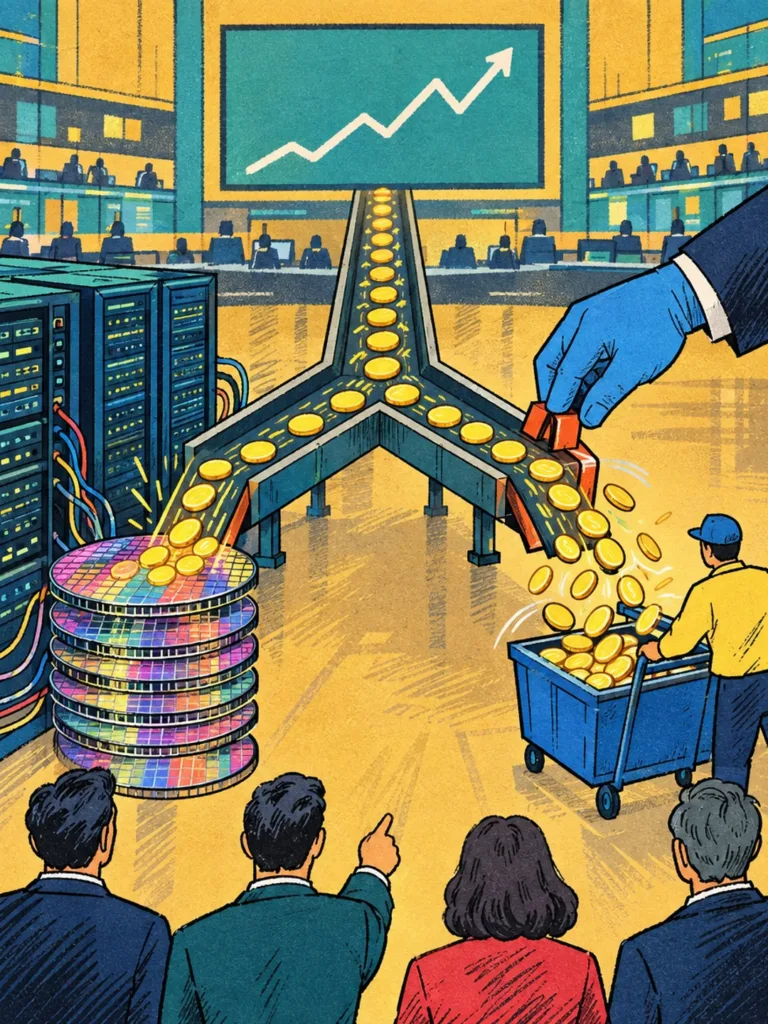
What foreigners bought that day wasn't the Korean market but the single No. 1 AI memory stock. When US memory stocks jumped overnight, money poured into SK hynix, the stock that most directly captures that expectation, while Samsung Electronics was actually sold.
Whether foreigners have returned to the Korean market is told not by one day's net buying but by the weekly totals for Samsung Electronics and SK hynix. That week, 75% of foreign net selling came from the two companies, and on the 18th, trading in SK hynix alone flipped the sign of the market-wide figure.
What changed that one day's direction wasn't anything happening in Korea either. Foreigners sold on the first day after the rate hike and bought the day after the US chip index rose more than 3%. Under the same benchmark rate, what changed foreigners' direction was not the Fed's hike but the US market the night before (falling Treasury yields and oil prices, and a chip rally).
When the daily figure and the weekly figure point in opposite directions, the weekly one is closer to where the money is going. Even including the SK hynix buying on the 18th, foreigners net sold more than KRW 6 trillion of the two companies that week. It is still too early to call it a ‘foreign return.’
Sources
https://www.federalreserve.gov/newsevents/pressreleases/monetary20260916a.htm
https://www.chase.com/personal/investments/learning-and-insights/article/federal-reserve-raises-rates-officials-signal-one-more-hike-in-2026
https://www.newspim.com/news/view/20260917000942
https://www.mediawatch.kr/news/article.html?no=261102
https://www.ajunews.com/view/20260917173600121
https://www.newspim.com/news/view/20260918000748
https://www.seoul.co.kr/news/economy/2026/09/18/20260918500257
https://www.pinpointnews.co.kr/news/articleView.html?idxno=488620
https://www.pinpointnews.co.kr/news/articleView.html?idxno=488543
https://www.pinpointnews.co.kr/news/articleView.html?idxno=488675
https://www.mt.co.kr/industry/2026/09/03/2026090318350022412
Glossary
Net buying — When the amount bought minus the amount sold is positive; it doesn't mean buying a lot, only buying even slightly more than was sold.
Benchmark rate — The base interest rate set by a central bank; when it rises, loan and deposit rates follow.
High bandwidth memory (HBM) — Premium memory that sits right next to AI chips and passes data quickly; demand grows as AI servers multiply.
Philadelphia Semiconductor Index — An index of leading US chip stocks such as Nvidia and Micron that shows the overnight mood in US semiconductors at a glance.
Preferred shares — Shares that pay slightly higher dividends in exchange for no voting rights on company management; in Korea their names end in ‘woo,’ as in Samsung Electronics Woo.
KOSPI — Korea's main stock index, covering the companies listed on the Korea Exchange's main board, such as Samsung Electronics and SK hynix.