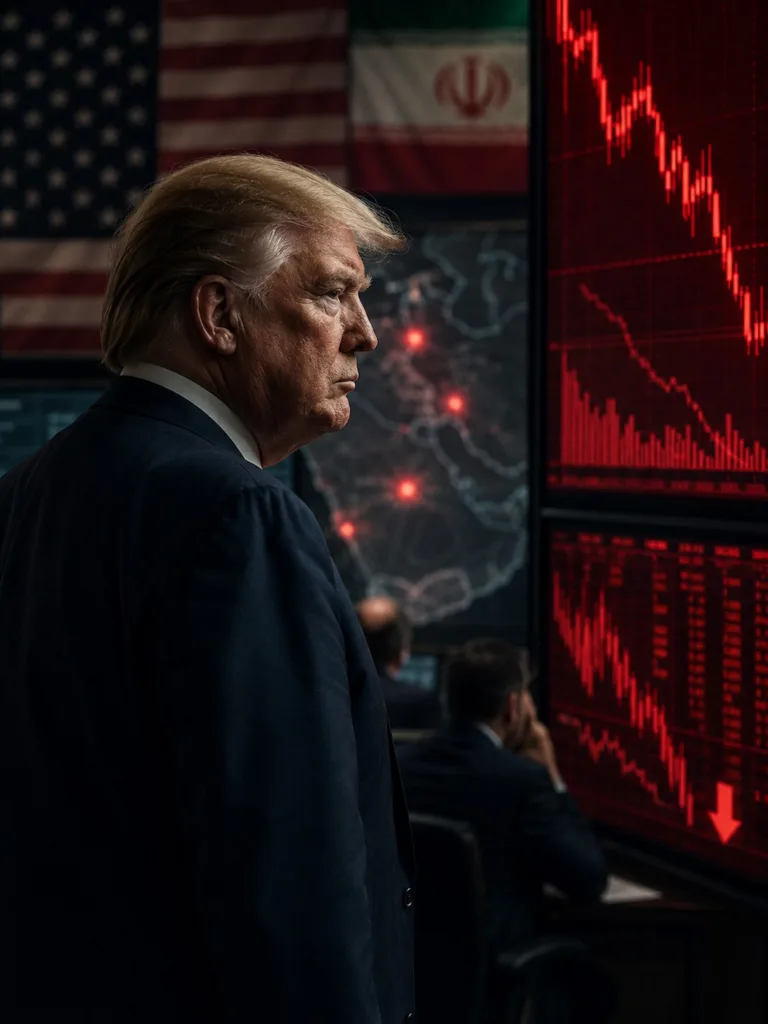
Right now your account is being rattled by war news. To avoid that, read Trump's timeline first.
Will stocks rise when the war ends? Tracking Trump's second-half scenario
- What the 2026 midterm elections mean for Trump
The U.S. midterm election is held in the second year of a presidential term to elect members of the House and Senate. Because it is not a presidential election, it might seem unrelated to Trump's own fate, but this November matters more to him than any election before. If Republicans lose the House, control of the budget passes to the Democrats and legislation stalls. His remaining two years would become a lame-duck administration.
Democrats have already launched their strategy to retake Congress and are making full use of polls showing Trump's approval rating hitting bottom. The conclusion is simple: Trump has to revive the economy before November. That is all there is to it. CNBC
- The Iran war wrecked Trump's plan
The Trump administration's original midterm strategy was to sell voters on the benefits of its tax cuts. When the Iran war broke out, oil prices soared, and the carefully laid strategy collapsed all at once. CNN
Trump's approval rating on handling inflation has fallen to 23%, and discontent over prices is rising fast even among Republican supporters. Trump started the war himself, yet that war is now shaking his own political base. aol
So what cards can Trump play?
- Scenario 1 — Declaring an end to the war (expected July–August)
The U.S. and Iran have already tentatively agreed to extend the ceasefire by 60 days. Trump is pushing to wrap up negotiations on the condition that Iran's nuclear program is dealt with and the Strait of Hormuz is reopened. CNN
Here is the scenario Trump wants: declare an end to the war or a formal ceasefire within the summer and push the message that “we won.” Trump has in fact said publicly that “once the Iran war is over, the U.S. economy will recover immediately.” The remark makes his intent plain: to use the end of the war itself as the trigger for an economic rebound. mexc
Right after news of the 60-day ceasefire deal broke, the Dow Jones topped 50,000 points intraday and oil prices turned lower. The market is already prepared to price in this scenario. CBS News
Expected market reaction: a short-term surge in the S&P 500 and KOSPI right after an end-of-war declaration, and a test of a break above $80,000 for Bitcoin. Bitcoin is currently moving sideways in the low $70,000s, a range where a single end-of-war catalyst could spark a strong rebound.
- Scenario 2 — Fed rate cuts (expected September–October)
Once the war is settled, the second card comes out: rate cuts.
Trump pushed out former Chair Powell and installed Kevin Warsh as the new Fed chair in May, and at the swearing-in he said publicly that “rates will come down very quickly.” Warsh has officially pledged independence, but the market knows he is sympathetic to Trump's position. CNBC
The Fed is currently holding rates at 3.5–3.75% and has signaled one cut within 2026. The problem is timing: the war-driven spike in energy prices has fueled inflation, pushing the cut that was originally expected in June into the second half. If oil prices stabilize after the war ends, the Fed will have a reason to move. aolaol
Expected market reaction: the moment of a rate-cut decision or a strong signal of one will create the stock market's second upward wave. Historically, risk assets respond strongly at the start of a rate-cutting cycle.
- Scenario 3 — A market peak before the midterms (October)
According to KB's market analysis, in U.S. midterm election years volatility has historically been high in the first half, while stocks have repeatedly recovered and rebounded from the second half onward. In 2026, this pattern is likely to play out in an even more compressed form because of the war. KB
Fidelity says the bull market in stocks is holding up despite the Iran conflict and that AI growth momentum could keep lifting the market. The S&P 500 is already trading near record highs. Fidelity
Putting it together, the most likely scenario right now is an end-of-war declaration in July–August, rate cuts in September–October, and a stock market peak in October. For Trump, the ideal picture is stocks hitting record highs just before the November vote.
- After that, be wary of what comes after November
You also need to keep in mind what happens after the peak. Once the election is over, Trump loses his political motive to push stocks higher artificially. The fiscal deficit has already widened because of war costs, and once the rate-cut card is played, there is less room left. From November into the fourth quarter, pressure for a correction could build.
Of course, this is a scenario. If any one thing goes wrong—a breakdown in nuclear talks with Iran, a renewed closure of Hormuz, or re-accelerating inflation—this timeline will be shaken. But if you know what Trump wants and which cards he is likely to play, in what order, to reach that goal, you can make different decisions from investors who are rattled by every line of war news.
| Period | Market conditions | Likelihood | Investor action |
|---|---|---|---|
| June–July | Ceasefire talks under way, volatility continues, direction undecided | High | Keep some cash on hand, prepare to enter in stages |
| August | Deal imminent or a lull, possible passage through the bottom | High | Start buying in stages |
| September–October | End-of-war declaration plus rate-cut hopes, rebound accelerates | Very high | Buy aggressively, increase exposure |
| November | Short-term peak around the election | High | Take profits, reduce exposure |
BITPRESS Insight
The key message of this article is one thing: what is shaking the market now is not the war itself but the political timeline surrounding it.
Trump needs an economic rebound story before November. The market has already begun partly pricing in the sequence of an end-of-war declaration, stable oil prices and Fed rate cuts. An end-of-war catalyst in July–August and rate-cut signals in September–October are likely to create two upward waves in stocks.
From an investment standpoint, the current stretch—with ceasefire talks dragging on and the market held down—may actually be the time to review your positions. Conversely, once the election is over after the October peak, watch out for profit-taking pressure. Instead of being dragged around by the news, first read who is moving this market and why.
URL Slug: trump-iran-war-end-rate-cut-market-timeline-2026
Tags (comma-separated): U.S.-Iran war, Trump, midterm elections, rate cuts, the Fed, Kevin Warsh, stock market outlook, Bitcoin, S&P 500, KOSPI, market timeline
Tags (#): #USIranWar #Trump #MidtermElections #RateCuts #Fed #KevinWarsh #StockMarketOutlook #Bitcoin #S&P500 #KOSPI #MarketTimeline
Sources
https://www.cnbc.com/2026/05/18/trump-hegseth-economy-2026-election-midterms-iran-china.html
https://www.cnn.com/2026/04/16/politics/republicans-house-iran-war-midterms
https://www.cnn.com/2026/05/31/politics/trump-iran-deal-changes
https://thehill.com/business/5872831-economy-trump-election-iran/
https://www.mexc.com/tr-CT/news/921805
https://www.cbsnews.com/live-updates/iran-war-us-trump-vance-ceasefire-strait-of-hormuz-deal-close/
https://www.cnbc.com/2026/05/22/trump-kevin-warsh-fed-chair-interest-rates.html
https://www.aol.com/articles/federal-holds-interest-rates-steady-181749477.html
https://kbthink.com/investment/tips/management/260429-2.html
https://www.fidelity.com/learning-center/trading-investing/stock-market-outlook