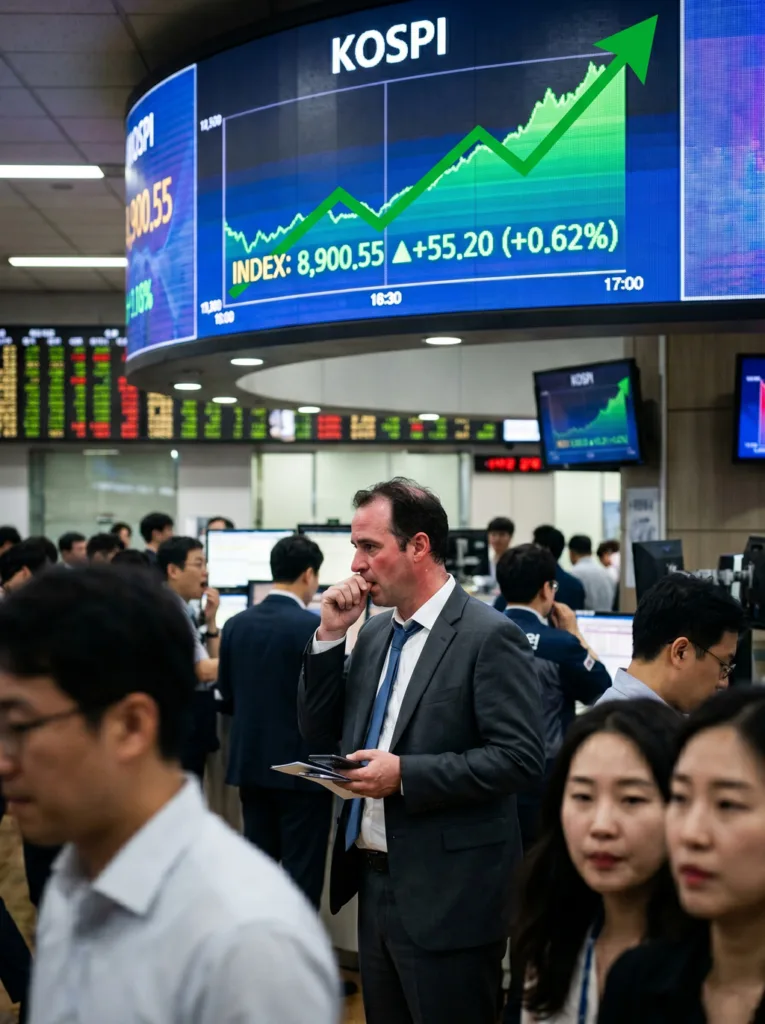
(As of June 2) The KOSPI broke above 8,900 intraday for the first time ever. But something is odd. Foreign investors dumped more than KRW 5 trillion in the morning session alone. Widen the lens to May and it is KRW 44.715 trillion; year to date, KRW 103 trillion. The pattern we are used to goes like this: foreigners buy first, retail investors pile in late, and foreigners sell to lock in gains. This market is different. Foreigners are selling at a record pace, yet the market keeps setting new highs. What is going on?
- Start with the numbers
According to the Korea Exchange, foreign investors were net sellers of KRW 44.715 trillion on the KOSPI in May, the largest monthly total on record. Their 16 straight trading days of net selling from May 7 to 29 was the longest streak since 2009, when the aftershocks of the global financial crisis were still being felt. And today, June 2, they have been net sellers of KRW 5.0531 trillion as of the morning session alone. Year to date, the total has passed KRW 103 trillion.
82% of the net selling was concentrated in two stocks, Samsung Electronics and SK hynix. Over the same period, by contrast, foreigners were record net buyers of KRW 2.837 trillion on the KOSDAQ. They sold the KOSPI and bought the KOSDAQ.
- So why isn't the market collapsing?
Foreign investors have sold KRW 103 trillion, yet the KOSPI broke above 8,900 for the first time today. There is one reason: there is money to absorb it.
As of this morning, retail investors were net buyers of KRW 5.6388 trillion, soaking up the entire foreign sell-off. For May as a whole, retail investors bought a net KRW 35.094 trillion, the largest retail net buying on record. Retail investors absorbed everything foreigners dumped, and the index actually rose.
- So why are they selling?
There are two main reasons.
The first is profit-taking. The KOSPI has surged more than 100% this year. Samsung Electronics is up 164% and SK hynix 258%. For foreign investors, it is quite literally a jackpot. The key point is that “selling because you dislike something” and “selling because it has risen too much” are completely different. The current selling is closer to the latter.
The second is rebalancing.
★ Note: Rebalancing — buying or selling part of a portfolio to restore target weights when the weight of a particular asset or country drifts away from its target. Global ETFs and institutional funds must track the country weights of their benchmark indexes, so when Korean stocks surge they mechanically sell some of their holdings.
Korea's weight in the MSCI Emerging Markets Index was about 11% as recently as the third quarter of 2025, but it had shot up to 21% as of May 2026, doubling in eight months. For global passive funds, Korea has simply become too big, so they have no choice but to trim it mechanically. You may hear claims like “if Korea's weight in the global market tops 2%, forced selling kicks in,” but that is not accurate. It differs by index, and it is not a forced cap but a process of adjusting by however much the weight has drifted from its target.
- Is ‘Sell Korea’ even the right term?
Here is the twist. Foreign investors have sold more than KRW 103 trillion, yet their ownership share has actually risen to around 38.5%, near a record high. How is that possible?
Foreigners sold non-leading stocks while holding on to core leaders such as SK hynix and Samsung Electronics, and because those leaders far outperformed the market average, the value of their overall portfolio actually grew. They cut the number of shares, but what they kept rose so much that its weight increased. In other words, the current foreign selling is not a “Sell Korea” exit but something closer to rebalancing—adjusting weights while taking profits.
- How long will foreigners keep selling?
There are three conditions under which foreign selling continues: when stock prices rise faster than earnings, when Korea's weight in global portfolios exceeds its target, and when currency risk grows. The conditions for selling to ease are just as clear. If earnings forecasts for Samsung Electronics and SK hynix are revised up again and the won stabilizes, foreigners could return as buyers. Hyundai Motor Securities noted that “net selling as a share of KOSPI market capitalization is smaller than in 2020–2022” and that “foreign investors maintain a positive view of the Korean market and memory chips.”
BITPRESS Insight
The key to this market is not “foreigners selling = bad.” If foreigners sold KRW 103 trillion and the KOSPI still broke 8,900, the question should shift from “why are they selling?” to “who is absorbing all those shares?” Right now, retail investors are. The problem is that many of them are using leverage such as margin loans. A market that doesn't fall even when foreigners sell can actually be more frightening. It is a sign that market leadership no longer rests with foreigners alone, but a structure in which leveraged retail buying props up the index can backfire as forced liquidations when a correction comes. There is no need to be scared by foreign selling figures alone. Instead, watch three things together: whether earnings forecasts for Samsung Electronics and SK hynix hold, whether foreigners keep buying the KOSDAQ while selling the KOSPI, and whether the KOSPI holds its highs despite foreign selling.
Sources https://www.mt.co.kr/stock/2026/06/02/2026060211015791899 https://www.sedaily.com/article/20050082 https://news.nate.com/view/20260531n06138 https://econmingle.com/economy/foreign-investor-sell-korea-paradox-msci-ai https://www.sedaily.com/article/20046481 https://www.ebn.co.kr/news/articleView.html?idxno=1709423