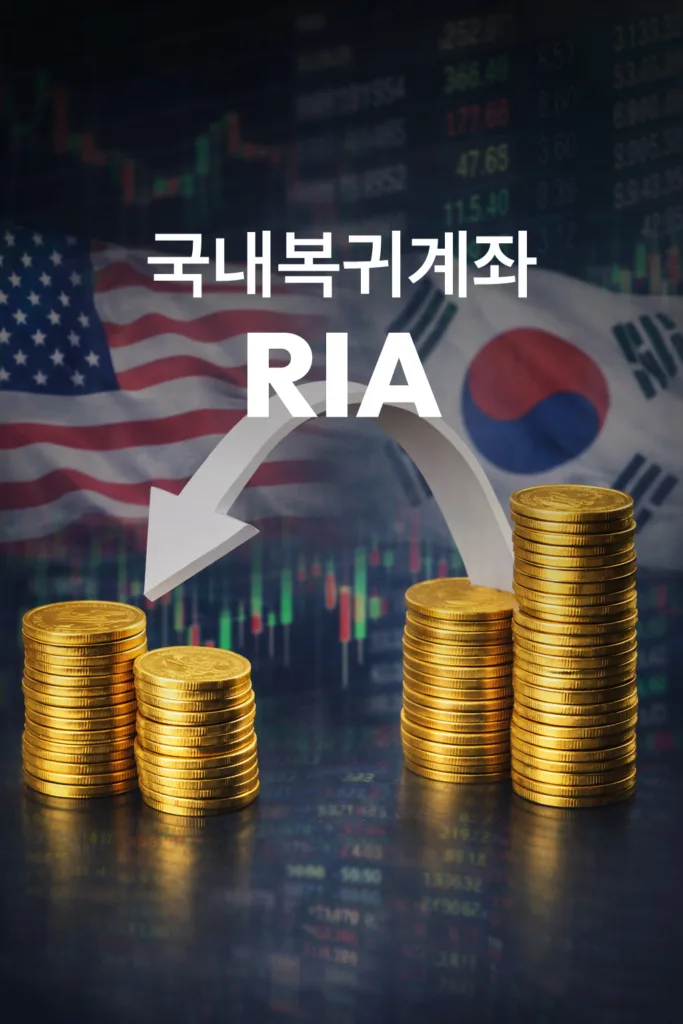
The Reshoring Investment Account (RIA) program, designed to bring overseas investment money back to Korea, officially took effect on March 23, 2026. It offers generous capital gains tax cuts, but it also comes with strict conditions on keeping the money in place and penalty clauses. Based on the program guide distributed by Samsung Securities, this article lays out the facts behind the 10 questions investors are most likely to ask.
Q 01. Is the capital gains tax exemption in an RIA account based on the profit, or on the total amount sold?
A. The exemption is based not on the profit but on the principal deposited, that is, the sale amount, and each person can receive the benefit on up to KRW 50 million in total across all financial institutions.
Q 02. If I go slightly over KRW 50 million, is the amount automatically cut to the limit so the benefit still applies?
A. According to the guide, you can only sell within the tax-free limit of KRW 50 million, and any shares above the limit must be moved back to a regular account. The system does not trim the amount for you; investors have to calculate the number of shares and sell them themselves.
Q3. Can I claim the existing KRW 2.5 million basic capital gains tax deduction on top of the RIA benefit?
A. The attached official Samsung Securities guide does not say whether the benefit can be combined with the existing KRW 2.5 million basic capital gains tax deduction, so it is unclear for now; you need to ask your local tax office or financial institution to confirm.
Q4. After selling through an RIA account, is there a problem if I buy the same overseas stock again in a regular overseas brokerage account?
A. As the guide stresses in red text, this can cause a serious problem. If you make new net purchases of overseas stocks or overseas-investing ETFs in other financial accounts between Jan. 1 and Dec. 31, 2026, the RIA account's tax benefit is reduced in proportion to that amount.
Q5. By when do I have to sell my overseas stocks to get a 100% capital gains tax exemption?
A. The reduction rate depends on when you sell. You must sell by May 2026 to receive the full 100% exemption; the benefit drops sharply to 80% for June to July and 50% for August to December.
Q6. Where must the money converted into won be invested?
A. Inside the RIA account, sale proceeds are automatically converted into won, and you must invest them in Korean listed stocks, Korean equity funds and ETFs, or savings and deposits to meet the conditions for the tax benefit.
Q7. What happens if I withdraw even a small part of the principal invested in Korean stocks before one year has passed?
A. If cumulative withdrawals of principal reach even KRW 1 and the account is closed, the capital gains tax reduction you received through the RIA account is taken back in full, so you must keep the account for one year from the last deposit date.
Q8. Can I buy new overseas stocks right now, move them into an RIA account and sell them for the benefit?
A. No. The capital gains tax reduction applies only when you transfer overseas stocks you already held as of Dec. 23, 2025 into an RIA account and sell them.
Q9. Do dividends paid before or after I sell overseas stocks also get the tax benefit?
A. Dividends are not covered. Stock and cash dividends from overseas stocks are automatically paid into a regular, fee-charging account, not the RIA account.
Q10. Can I open RIA accounts at several brokerages?
A. Each brokerage allows one account per person, so you can open accounts at more than one firm, but the KRW 50 million deposit limit is managed as a single total across all financial institutions, so be careful not to exceed it.
BITPRESS Insight: The core of the RIA account program, as seen in the Samsung Securities guide, is the government's strong will to follow up closely and leave no loopholes in the benefit it offers. Investors must not only stick precisely to the KRW 50 million sale limit, but also keep in mind that buying even a single net share of overseas stock in another account during 2026 will cut the tax benefit. And while the principal cannot be withdrawn at all for one year, profits earned by investing in Korean assets can be withdrawn freely, so it pays to consider a conservative domestic strategy built around savings deposits or dividend stocks.