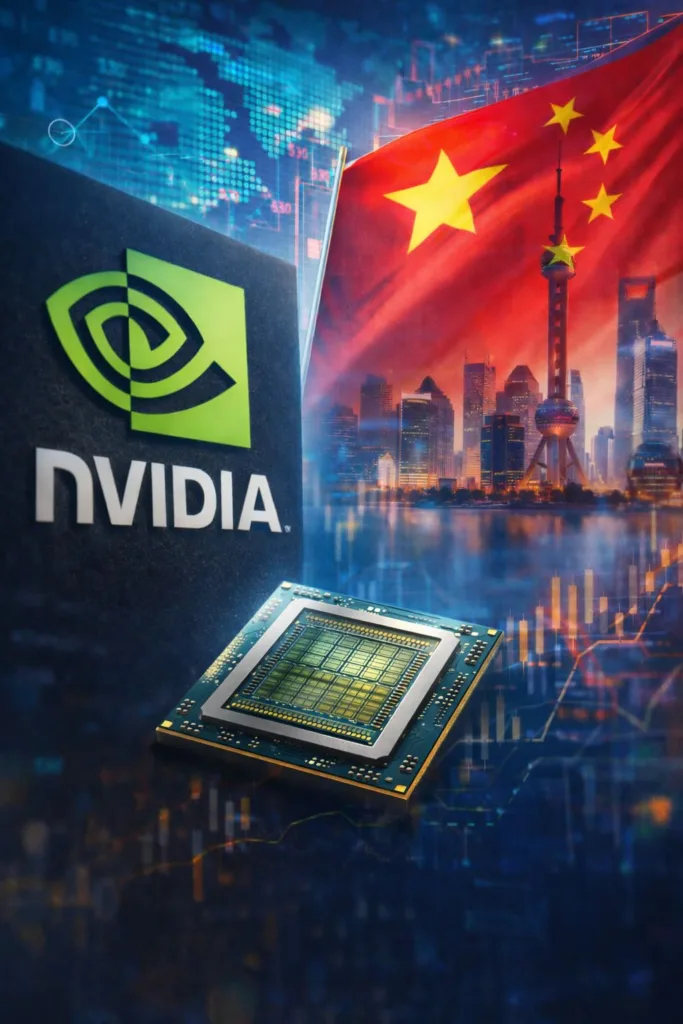
The debate over Chinese demand for Nvidia continues. After export controls triggered talk of a “collapse,” the mood has recently reversed as the U.S. conditionally approved exports of the H200 chip to China. But this is not simply good news. Given the global AI investment cycle and Nvidia’s technology lead, its 2026 growth story remains solid. Here are the latest facts.
China: limited demand returns as rules ease
Under sweeping U.S. export bans from 2022 to 2024, Nvidia all but gave up selling top-tier GPUs such as the H100 and A100 in China. China’s share of its revenue fell from the 20% range to 13%, while domestic chips such as Huawei’s Ascend surged. Some forecasts even say Nvidia’s share of China’s AI chip market could fall from 66% to 8% in 2026.
In January 2026, the U.S. Commerce Department changed course. By introducing “case-by-case licensing” for the H200 chip**(the next-generation version of the H100, a GPU optimized for AI training with larger memory capacity and higher performance)**, it allowed Chinese cloud companies to place orders of up to 50% of U.S. sales volume, for non-military use only. It is not the explosive demand of the past, but high-end demand from the world’s second-largest market has returned on a limited basis.
Key point: China is shifting from a “high-growth bonus” to a “steady contributor.” The collapse theory is overblown, and the boom theory is a stretch too.
Global AI demand: a 2026 CAPEX surge expected
Despite the China risk, Nvidia’s main stage is global Big Tech. The data center GPU market is forecast to grow from $20 billion in 2025 to $260 billion in 2035, at 20%-plus a year.
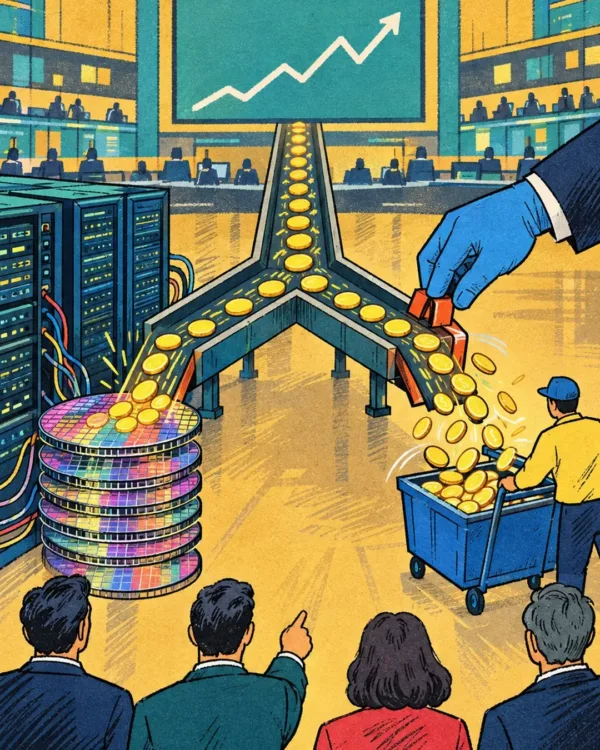
Of the Big Five’s (Amazon, Google, Meta, Microsoft, Alibaba) $600 billion in 2026 capital spending, $450 billion is expected to go to AI infrastructure. GPUs are evolving from simple chips into “infrastructure assets” tied to power and space. Supply bottlenecks also persist, keeping demand > supply through 2026.
Nvidia dominates the AI platform with GPUs + networking + CUDA**(Nvidia’s proprietary AI software platform, an ecosystem that does not work on rivals’ chips)**. Its edge is not just in chips but across the whole ecosystem.
Nvidia earnings and roadmap: topping $200 billion in 2026
S&P and others expect fiscal 2026 revenue of $205 billion (90% from data centers) and $270 billion in 2027.
- Blackwell: An architecture slated for release in late 2025. Up to 50 times the performance of Hopper (the basis of the H100/H200) on certain AI workloads. The GB300 is the flagship GPU built on this architecture.
- Rubin: A next-generation architecture slated for release in late 2026. Theoretical performance 3.3 times that of Blackwell and 165 times that of Hopper. Essential for training large LLMs.
This roadmap is expected to let Nvidia monopolize demand for large AI models. There is competition from AMD, Intel and Big Tech’s in-house chips, but with supply tight through 2026, Nvidia’s lead is clear.
Investment takeaways: China is an option; the core is the AI platform
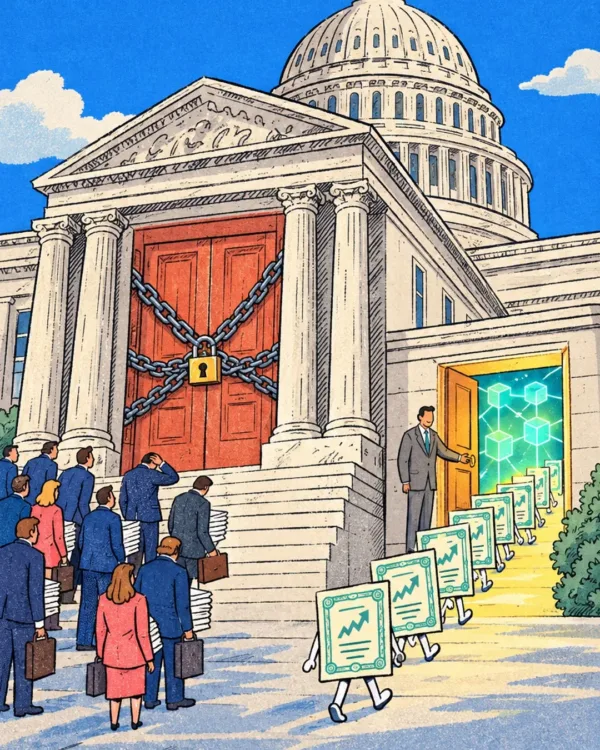
The H200 news is a short-term positive, but the risks of congressional pushback and renewed restrictions remain. China is now at the level of “option value,” less than 10% of total revenue.
Key points for 2026
- Strengths: Surging Big Tech CAPEX, the Blackwell and Rubin roadmap lead
- Risks: Regulatory changes, intensifying competition, cyclical correction
Don’t be shaken by China headlines; watch quarterly inventory, margins and competitive share.
BITPRESS Insight
Nvidia’s value in 2026 lies not in China (a possible 5–10% premium) but in Big Tech CAPEX and the Rubin launch cycle. The investment strategy is simple:
- Medium-term view: Lock in 20%+ growth from data centers’ 90% share of revenue and the Blackwell-to-Rubin transition
- Risk management: Ignore China regulation news; instead track the share of AMD’s MI300X**(AMD’s latest AI GPU)** and Big Tech’s in-house chips
- Timing: Aim for the point when Q2 CAPEX becomes visible after the Q1 inventory adjustment
China is noise; the AI infrastructure platform is the core. Just watch the numbers.