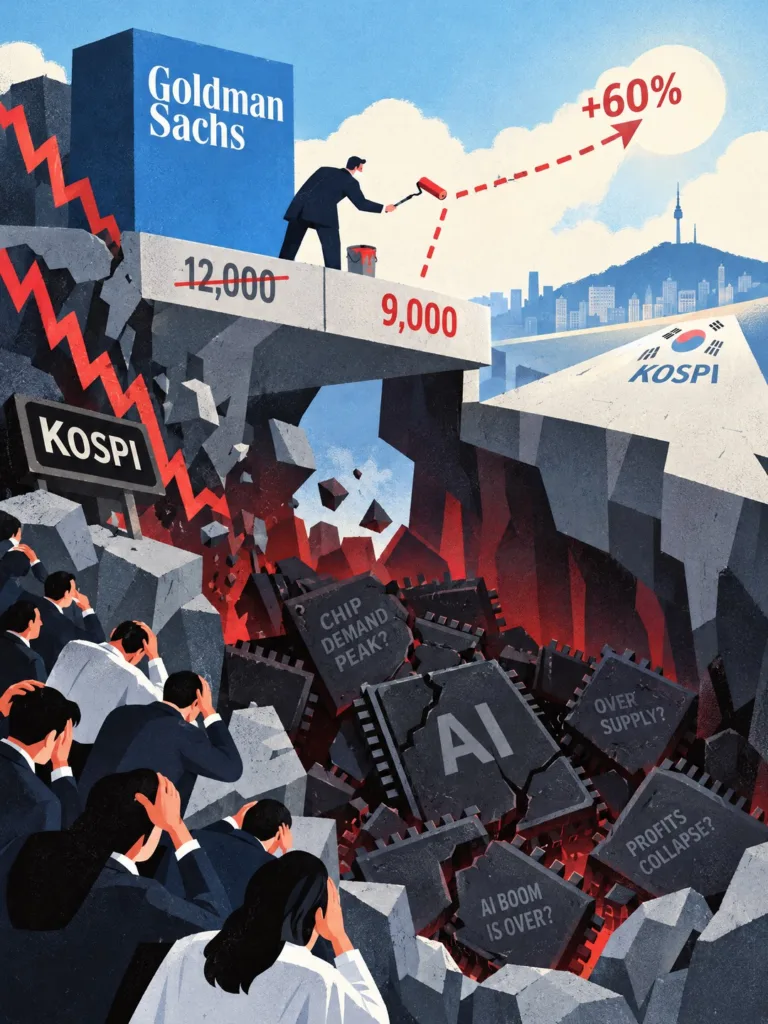
Goldman Sachs has cut its 12-month KOSPI target by 25%, from 12,000 to 9,000. It had raised the target from 9,000 to 12,000 in June and held it through the selloff in AI-related stocks. Meanwhile, the KOSPI has fallen more than 35% from its June peak.
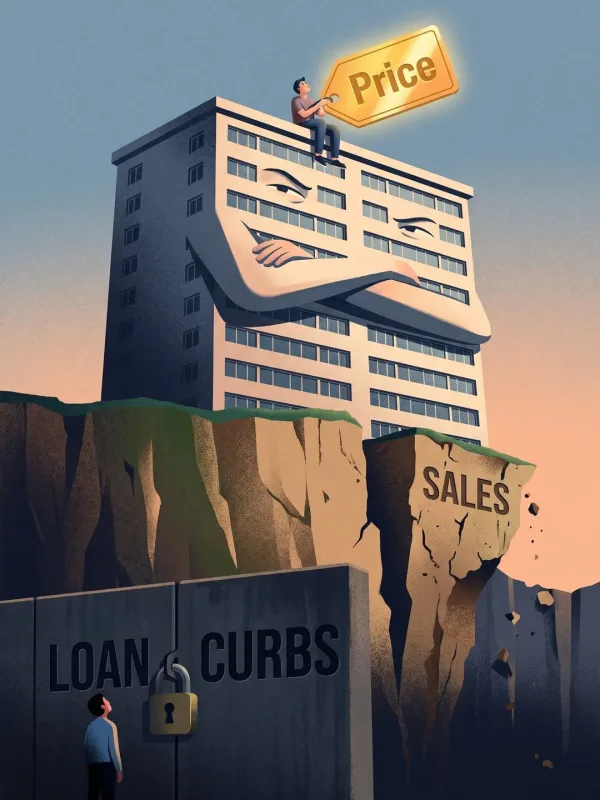
The common reading is that when even a leading bull cuts its target by a quarter, it is a warning that stocks will fall further. But the same report also shows that even the lowered 9,000 is more than 60% above where the index stands now. What matters is not the target itself but what is already priced into the KOSPI today.
- What did Goldman Sachs cut?
Goldman Sachs strategists including Timothy Moe said they lowered the target "to reflect more conservative assumptions about how the market values companies' fundamentals." In other words, they cut the assumption used to value companies: how many times earnings a stock can be worth.
Think of buying and selling a shop. It is like deciding how many years of profit to pay for a shop that earns about $7,550 (KRW 10 million) a year. Even if its earnings stay the same, offering 6 years' worth of profit instead of 8 lowers the price. But whether the target was cut because the shop earns less or because buyers credit fewer years is a separate question.
- Why does it still see more than 60% upside after cutting the target?
The KOSPI closed at 5,550.30 on Oct. 23. A level of 9,000 is about 62% higher. Because the index is already down more than 35% from its June peak, the target is still far above today's level even after a 25% cut.
If you had put $7,550 (KRW 10 million) into the KOSPI, it would grow to about $12,230 (KRW 16.2 million) if the index reaches 9,000. Of course, that figure assumes Goldman Sachs's forecast turns out right.
- What is already priced into the KOSPI now?
By Bloomberg's count, the KOSPI's 12-month forward price-to-earnings ratio (P/E) has fallen to about 4 times. There is little precedent for that among 18 major stock markets since 2006. Even Indonesia's market, which MSCI (the company that builds the world's stock indexes) has warned it could downgrade, trades at 8. When it raised its target in June, Goldman Sachs put the KOSPI's forward P/E at 8.2. The two figures come from different sources, but the ratio has roughly halved in a little over four months.
Put simply, the market is pricing Korean companies as if they could be bought for just four years of expected profit. Oddly, profit forecasts actually rose over the same period. While the KOSPI fell sharply from its June peak, its 12-month forward earnings estimate rose 22%. That reads as the market not believing the forecast. Goldman Sachs estimated that chip stock prices already reflect a case in which semiconductor sector profits fall 65% in 2027, and called that "an overly pessimistic scenario." The P/E for stocks outside memory is 7.6, about double that of the index as a whole.
- Why is the market so pessimistic?
The market has its reasons. In the month from Sept. 23 to Oct. 23, Samsung Electronics fell 24.52% and SK hynix fell 31.42%. Foreign investors have net sold $180.4 billion (KRW 238.9118 trillion) of shares on the KOSPI market so far this year through Oct. 23, and 82.5% of that was in these two stocks.
Over the past year, operating profit estimates for the two companies rose 20–30% a month, but in the last two to three months the forecast for 2027 operating profit growth has stalled at 0–1%, according to one assessment. Bloomberg noted growing worry over whether the massive AI infrastructure spending can continue. Once the ever-rising profit outlook stopped, the fear that it could turn down was priced in first. JPMorgan also said that, judging by buying and selling flows, it is too early to say a bottom has been confirmed.
- Where does Goldman Sachs still stay positive?
Goldman Sachs kept its positive outlook on power, industrials, stocks tied to corporate governance reform, and beneficiaries of a domestic demand recovery and Korean pop culture. All of these sectors are far removed from the chip profit cycle.
Put simply, it picked areas that can make money for reasons unrelated to the debate over how far chip profits will fall. Its June report also said it was positive on power supply stocks.
- BITPRESS Insight
A lower target does not mean "sell." Goldman Sachs only made its assumptions more conservative; its view that today's price reflects excessive pessimism is unchanged. A target can move a lot just by changing how many times earnings the brokerage is willing to pay.
What really divides investors lies elsewhere. The KOSPI's price today already assumes a future in which chip profits shrink sharply. If actual profits turn out better, prices have room to rise; if they turn out worse, even a P/E of 4 is hard to call cheap. Goldman Sachs itself held 12,000 and then cut it in under five months, which shows a target is an assumption, not a promise.
Read news that a brokerage lowered its target by asking not "how much did it cut?" but "how bad a future is today's price already assuming?"
Sources
https://www.mt.co.kr/world/2026/10/26/2026102606194728561
https://biz.heraldcorp.com/article/10914036
https://kr.investing.com/news/stock-market-news/article-2140260
https://www.hankyung.com/article/2026102535151
https://www.hankyung.com/article/2026060350891
https://www.bloomberg.com/news/articles/2026-10-25/goldman-cuts-kospi-12-month-target-by-25-as-ai-trade-unravels
Glossary
12-month forward price-to-earnings ratio (P/E) — The current share price divided by the profit expected over the next 12 months; the lower it is, the cheaper the stock is relative to its earnings.
Target — The level a brokerage thinks an index or stock could reach within a set period (here, 12 months); it is a forecast built on assumptions, not a promise.
Valuation assumption — The premise used when valuing a company, such as how many times its earnings to pay.
Upside — How many percent higher a price could still go from today's level to the target.
MSCI — A company that builds the stock indexes investors around the world use as benchmarks; if a market's rating is downgraded, money tracking that index can leave.
KOSPI — South Korea's main stock market index; it tracks the share prices of the largest companies listed on the Korea Exchange, so it is often used as a gauge of the whole market.
BITPRESS articles are information to help your investment decisions, not a recommendation to buy or sell any stock or coin. Investment decisions and their results are your own responsibility.