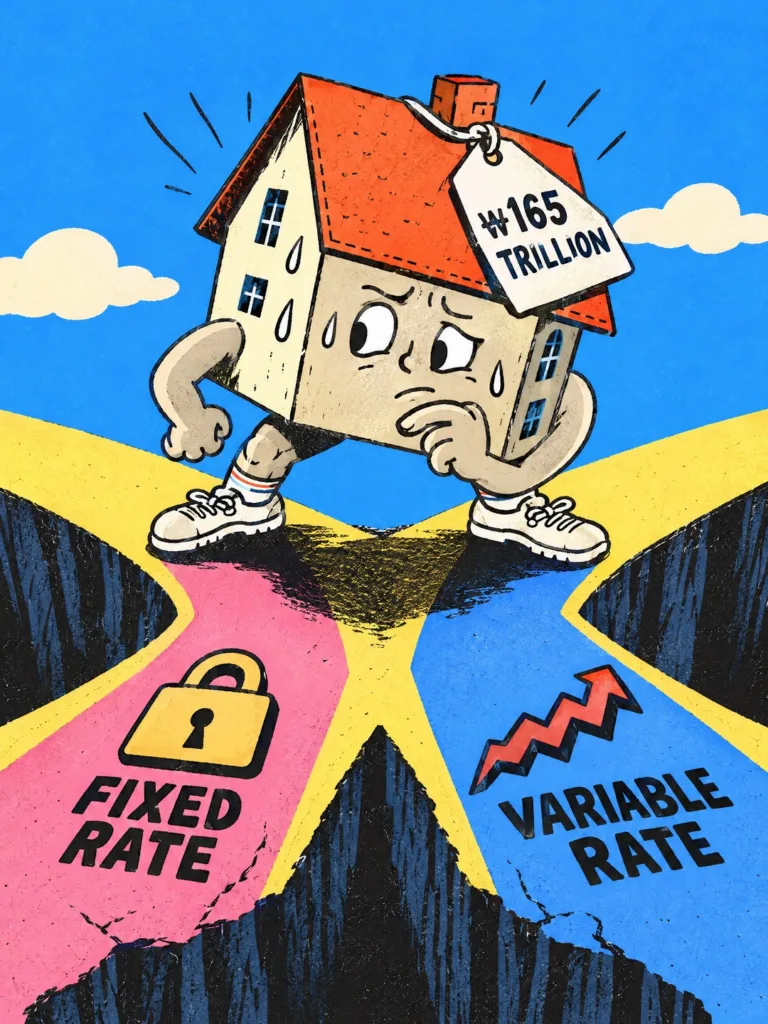
This year, 165 trillion won (about $124.6 billion) in bank mortgages will get a new interest rate between October and December. That is 21.1 trillion won (about $15.9 billion) more than last quarter. A rate being reset means the rate fixed a few years ago ends and the loan switches to today's rate. For someone who borrowed 200 million won (about $151,000) at 3%, the monthly payment could rise from around 940,000 won (about $716) to as much as around 1.3 million won (about $985).
The common reading is simple: rates are rising, so locking in a fixed rate is better. But at bank counters recently, fixed rates (on hybrid, fixed-then-variable, mortgages) actually fell while variable rates rose. The key is that the two rates follow different benchmarks, so the answer depends less on 'which is cheaper?' than on 'how many more years will you carry this loan?'
- Which loans make up the 165 trillion won (about $124.6 billion)?
According to data the Financial Supervisory Service gave to the office of Rep. Han Chang-min of the Social Democratic Party, mortgages at 19 domestic banks scheduled for a rate change from October to December, excluding policy mortgages, total 165 trillion won (about $124.6 billion). That includes loans that were variable-rate from the start, so not all of them are loans whose five-year fixed period is ending.
The part to watch is loans taken out in 2021 with a five-year fixed rate. When the fifth-year contract date arrives, their rates change in turn. A hybrid mortgage (fixed for the first few years, then variable) moves to a variable rate, and a five-year periodic-reset mortgage gets a new rate to use for the next five years. It is similar to a phone plan changing when your contract ends. The difference is that a loan left alone simply gets the new rate under its terms.
- How much does the monthly payment change on 200 million won (about $151,000)?
If you borrowed 200 million won (about $151,000) at 3% over 25 years with equal principal-and-interest payments (paying the same amount every month), you pay about 948,000 won (about $716) a month. After five years of paying this way, about 171.01 million won (about $129,100) of principal remains.
Apply 6.795% a year, the top of the five big banks' variable-rate range, to that remaining balance over 20 years, and the payment is about 1.305 million won (about $985) a month. That is about 356,000 won (about $269) more a month, or about 4.28 million won (about $3,231) more a year. At the low end, 4.42% a year, the payment is still about 1.075 million won (about $811), which is more than 120,000 won (about $91) higher. Actual rates differ from person to person depending on the benchmark rate, add-on margin and preferential terms in the original contract.
Put simply, a loan locked at a low rate five years ago costs more every month whether you choose fixed or variable.
- Recently, variable rates rose while fixed rates fell
As of Oct. 23, variable mortgage rates tied to new-business COFIX (the cost of funds index) at the five big banks (KB Kookmin, Shinhan, Hana, Woori and NH Nonghyup) are 4.42% to 6.795% a year. That is up 0.07 percentage points at the low end and 0.03 percentage points at the high end from the end of September. By contrast, hybrid-mortgage rates based on the five-year bank bond are 4.62% to 6.993%, down 0.28 percentage points at both ends recently.
The two rates follow different benchmarks. COFIX, the benchmark for variable rates (the average rate on money that eight banks raise through deposits, installment savings, bank bonds and the like), was 3.43% for September's new business, up 0.25 percentage points in a month. That is the biggest jump in 3 years 10 months, since November 2022. It is read as the effect of banks raising deposit rates one after another in September to hold on to retail deposits after corporate cash drained out to pay corporate taxes. A hybrid mortgage follows the yield on five-year bank bonds.
It is like the price at the gas station today and a contract price set a year in advance moving separately.
- What are you buying if you choose fixed now?
Comparing the lowest rates, the hybrid 4.62% is 0.2 percentage points higher than the variable 4.42%. As in the earlier example, if the remaining 171.01 million won (about $129,100) is repaid over 20 years, the payments during the first five fixed years are about 1.093 million won (about $825) and 1.075 million won (about $811), a difference of about 18,000 won (about $14).
Fixed is like insurance: you pay this extra 18,000 won (about $14) to protect yourself for five years against rates going up. If variable rates stay more than 0.2 percentage points higher over those five years, fixed comes out cheaper; if they stay put or fall, variable is cheaper. At the high end too, hybrid is higher, and actual rates differ by bank and terms.
- What does the direction of rates depend on?
The Bank of Korea raised its benchmark rate in July and August to 3.0%, then held it on Oct. 22. Markets expect one more hike, to 3.25%, at the November Monetary Policy Board meeting. COFIX moves with deposit rates, so continued hikes could put upward pressure on variable rates too.
With variable, payments can rise if the hikes happen; with fixed, you do not benefit for five years even if rates fall.
- A five-year-old loan has less to fear from prepayment fees when you switch
If you decide the other type is better, you have to switch loans. Under the Financial Consumer Protection Act, prepayment fees are banned in principle and can be charged only when you repay within three years of the loan date. A five-year-old loan is already past those three years.
On the other hand, a newly switched loan starts a fresh three years from that day. If you plan to sell the home or repay with a lump sum within two to three years, factor in the new loan's fee too.
- BITPRESS Insight
Seoul apartment prices rose for 88 straight weeks through the second week of October. Meanwhile, payments for owners who locked in low rates five years ago rise in turn through year-end. Choosing fixed or variable is a choice about how to pay that extra money over the years ahead.
If a loan has nearly 20 years left and you do not plan to pay it off, the risk of rates rising builds up over a long time, so there is more reason to pay the 'premium' of roughly $14 a month in the earlier example and lock in five years. If you plan to repay or sell within a few years, you cannot use that insurance for long, so the benefit of the lower rate now grows.
Before asking which of fixed and variable is cheaper, decide how many more years you will carry this loan.
Sources
https://www.g-enews.com/article/Finance/2026/10/202610251210258071e30fcb1ba8_1
https://biz.sbs.co.kr/amp/article/20000340193
https://inews24.com/view/2015524
https://www.hankyung.com/article/2026102535301
https://www.smarttoday.co.kr/ko-kr/articles/110859
https://www.fnnews.com/news/202501091251452034
https://www.segye.com/newsView/20261015509765
Glossary
COFIX — The average interest rate on the money eight banks raise through deposits, savings accounts, bank bonds and similar funding. It is the benchmark for variable-rate mortgages.
Hybrid (fixed-then-variable) mortgage — A mortgage that uses a fixed rate for the first few years (usually five), then switches to a variable rate.
Periodic-reset mortgage — A mortgage whose rate is reset at set intervals (for example, every five years) and then stays fixed until the next reset.
Equal principal-and-interest repayment — A repayment method in which you pay the same amount every month, with principal and interest combined.
Prepayment fee — A fee paid to the bank for repaying a loan before it is due. Currently it can apply only when you repay within three years of the loan date.
BITPRESS articles are information to help your investment decisions, not a recommendation to buy or sell any stock or coin. Investment decisions and their results are your own responsibility.