Seoul apartment sales fell from 8,946 in May to 4,589 in August. That is a 48.7% drop in three months. When sales dry up this much, it is easy to assume that falling prices come next.
But the median sale price of a Seoul apartment in September (the price of the home in the middle when apartments are lined up by price) was KRW 1.086 billion, 13.4% higher than last December. Sales halved, yet prices did not come down.
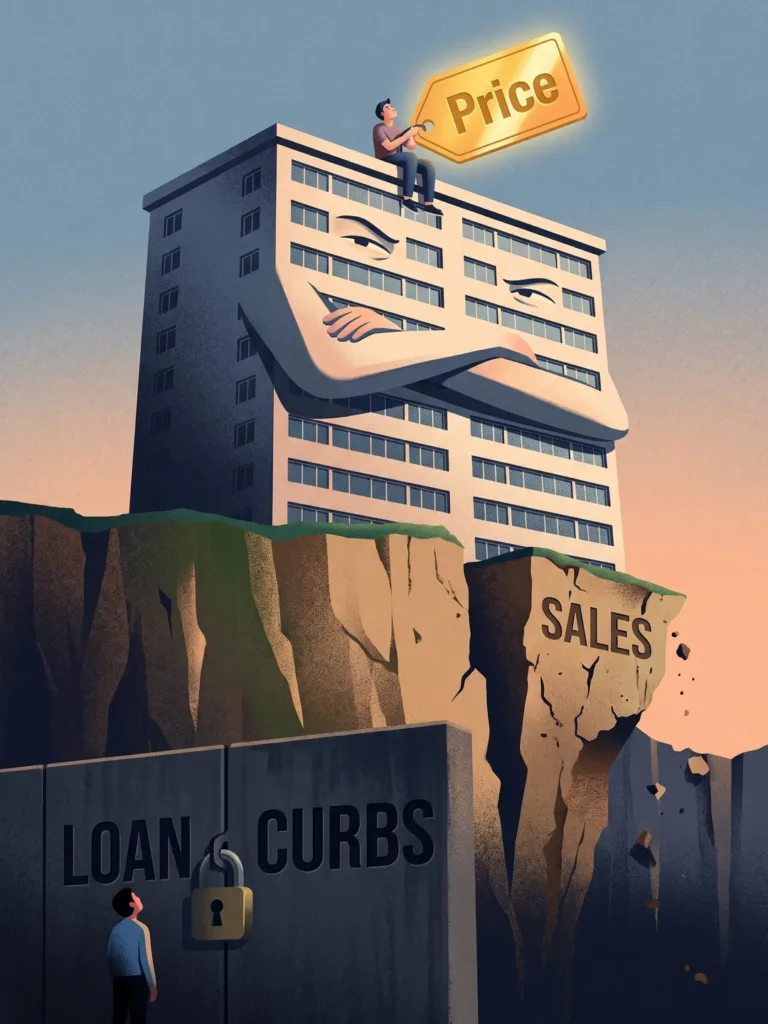
The point lies elsewhere. Loan curbs have added to the burden on buyers, while sellers have not cut their asking prices. So prices hold and only sales dry up.
- How much did Seoul apartment sales fall in three months?
Seoul apartment sales fell every month: 8,946 in May, 7,742 in June, 6,564 in July and 4,589 in August. It was not one sharp drop but three straight months of decline.
In a neighborhood where 100 homes a month used to sell, only 51 would sell three months later. Put simply, Seoul apartment sales have almost halved.
- If sales fell, why haven't prices come down?
Kim Hyo-seon, senior real estate specialist at KB Kookmin Bank's WM Star Advisory Group, said, "Loan curbs and other factors have increased buyers' burden of raising funds, while sellers are holding to their asking prices in the hope that prices will rise, which is dampening sales." An asking price is the price a seller names, saying, "I will sell at this price."
Kim's explanation, step by step, goes like this. Loan curbs make it harder for buyers to raise the money → sellers expect prices to rise further and do not lower their asking prices → the gap between what buyers want to pay and what sellers want to get widens → sales fall, and prices do not come down.
Think of a secondhand marketplace app. If sellers will not cut their prices and buyers are short of money, prices do not fall; the "for sale" posts just stay up for a long time. The difference is that a home costs hundreds of millions of won, so when loans are blocked, the number of people who can pay that price shrinks.
- Prices held, but the pace of increase has almost stopped
Prices not falling does not mean they are rising as before. The monthly gain in the average sale price of Seoul apartments slowed from 1.15% in June to 0.01% in September.
On a home worth KRW 1 billion, that is a rise of about KRW 11.5 million in a month in June, but only about KRW 100,000 in September (a hypothetical calculation). Put simply, home prices have not fallen, but they have effectively stopped in place.
The two measures also need to be told apart. The 13.4% above compares the price of the home in the middle with last December, while the 1.15% and 0.01% are the rates at which the average price rose in a single month. The 13.4% does not mean the same home rose that much. Still, the months when sales fell overlap with the months when the pace of increase slowed.
- Even within the Seoul average, some districts fell
"Prices are not falling" is a story about the Seoul-wide average. In the third week of October (as of the 19th), Seoul apartment prices rose 0.13% in a week. The 14 districts in northern Seoul (Gangbuk) rose 0.26%, but Seocho district fell 0.32% and Gangnam district fell 0.31%.
From January through Oct. 26 this year, deals of KRW 1.5 billion or more made up 81.4% of apartment sales in Gangnam district and 75.4% in Seocho district, versus 0.1% in Nowon district. At least in this one week, the districts packed with expensive homes fell while the relatively cheaper northern districts rose, so they moved in opposite directions. The Seoul average alone hides such differences.
- BITPRESS Insight
Reading a sales cliff as a sign that prices are about to fall is easy to get wrong. This time the burden grew on the buyers, and sellers, expecting prices to rise further, held to their asking prices. In such a case prices do not fall; only sales dry up.
But a price set while sales have halved is a price set by few deals. When prices rise and sales rise too, many people accepted that price. When sales stay halved and only the price holds, not many people are willing to buy at that price.
There are two ways this standoff ends. If the loan route reopens and buyers accept the price, sales pick up and the price firms. If sellers cut their asking prices first, sales pick up as prices fall. Either way, the direction shows once sales pick up again.
So when you read home-price news, look not only at how much the price rose but also at how many homes sold at that price and whether the pace of increase is speeding up or slowing down. A price without sales is not a rise; it is a standoff.
Sources
https://www.etoday.co.kr/news/view/2640590
https://www.gukjenews.com/news/articleView.html?idxno=3730092
Glossary
asking price — The price a seller lists a home at, saying "I'll sell at this price." It can differ from the price at which homes actually sell.
median sale price — The price of the home in the exact middle when sold apartments are lined up in order of price. It is less affected by a few very expensive homes.
sales cliff — A term for when the number of home sales drops sharply over a short period.
BITPRESS articles are information to help your investment decisions, not a recommendation to buy or sell any stock or coin. Investment decisions and their results are your own responsibility.