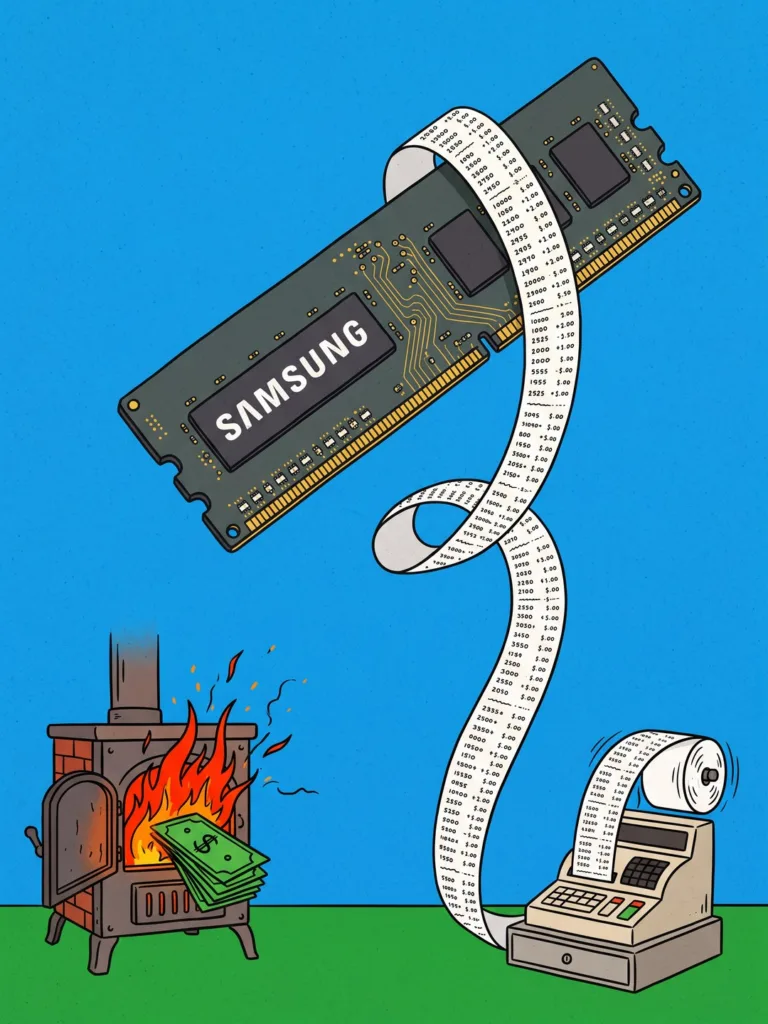
On Oct. 27, Samsung Electronics shares closed up 4.23% at KRW 222,000. The day before, in the U.S., Anthropic (the U.S. company that makes the AI model Claude) had filed a registration statement for an IPO. On Oct. 22, it was the opposite. The day after Meta (the owner of Facebook and Instagram) raised its outlook for AI capital spending (capex), Samsung Electronics closed down 4.03% at KRW 214,500, after rising 5.67% the day before.
The common explanation is “chip stocks bounced on hopes for Anthropic's IPO.” But the real point lies elsewhere. Meta said it would spend more, while Anthropic showed numbers suggesting its revenue is growing faster than the money it spends. Brokerages said the market's focus has shifted from “how much is being spent on AI” to “is anyone earning enough to pay for it.”
- Meta says it will spend more, so why did Samsung Electronics fall?
When Meta reported third-quarter results on Oct. 21 (U.S. time), it adjusted its capex outlook for the year from $130 billion–$145 billion to $135 billion–$145 billion. Third-quarter spending alone was $34.9 billion, including repayment of finance lease principal, up about 80% from a year earlier. Because that money goes into AI data centers, the news could have meant more demand for memory chips.
The same report also had a worry in it. Third-quarter free cash flow (the cash left after subtracting capex from the cash earned from operations) was a $2.12 billion deficit, a swing from a $10.63 billion surplus a year earlier. Operating profit fell 37% from a year earlier, after reflecting the cost of a large legal settlement. Put simply, Meta is now spending more than the cash it earns.
On Oct. 22, the KOSPI fell 3.52%, with Samsung Electronics down 4.03% and SK hynix down 5.49%. KB Securities described it as a pullback in large chip stocks after the previous day's surge. Meta's shares also fell 6.98% in the U.S. that day. Meta has not disclosed the revenue or profit of its AI agent “Muse.”
- What did Anthropic's filing show?
On Oct. 26 (U.S. time), Anthropic filed a registration statement (Form S-1, a document that discloses results and risks before a listing) with the U.S. Securities and Exchange Commission (SEC). Its first-half revenue this year was $16.286 billion (about KRW 21.6 trillion), roughly 14 times a year earlier. In the second quarter, it posted an operating profit of $974 million, turning profitable for a quarter.
Revenue and costs also grew at different speeds. Second-quarter revenue was $11.555 billion, up about 144% from the previous quarter, while computing and infrastructure costs were $5.558 billion, up about 64%. In other words, revenue grew faster than costs.
- How much revenue did each $1 of computing bring in?
According to Meritz Securities, Anthropic's revenue per $1 of computing cost rose from $0.57 in the second quarter last year to $2.07 in the second quarter this year. Put another way, KRW 10,000 (about $7.55) spent on chips and data centers brought in KRW 5,700 of revenue a year ago. Now it brings in KRW 20,700.
Think of a taxi driver. If KRW 10,000 of fuel earns KRW 5,700 in fares, there is no reason to add cars, but if it earns KRW 20,700, buying more cars makes sense. Still, other costs such as pay are also taken out of revenue, so the second-quarter operating margin was 8.4%.
- Why does Samsung Electronics' name appear in the filing?
In the filing, Anthropic named SK hynix, Samsung Electronics and Micron as the main makers of HBM (high-bandwidth memory, memory that sits next to an AI chip and moves data in and out quickly) and other high-performance memory. It said it cannot guarantee that supply will grow fast enough to meet demand, even if they expand production.
It also wrote that if large customers or competitors lock up supply first, its access to chips could suffer. The company itself lists the chance of not getting memory on time as a risk. Brokerages said that as confidence grows that AI companies' profits will keep investment going, the outlook for HBM demand could improve too.
Once the improving profitability was confirmed, buying came into Korean chip stocks as well. On Oct. 27, foreign investors net bought KRW 835.9 billion (about $631 million) of KOSPI stocks. In Samsung Electronics, foreign investors bought KRW 221.6 billion (about $167 million) and institutions KRW 92.9 billion (about $70 million), and the KOSPI closed up 3.09% at 5,638.34.
- Are the worries gone?
It is too early to treat one company's profit in one quarter as relief from the investment burden across the whole industry. Yang Hyun-kyung, a researcher at iM Securities, pointed out that companies are raising investment faster than the cash they earn and relying on outside funding such as share issues and leases. Yang said this is positive for memory chips in the short term, but that for investment to continue, funding conditions and the timing of cash recovery must hold up.
Seo Sang-young, a division head at Mirae Asset Securities, said the listing is a test of whether AI companies' high valuations are backed by steady cash flow, and that how the shares trade after the mid-November listing will matter.
- BITPRESS Insight
Both stories were about “money keeps flowing into AI.” The difference was the position of the side providing the money. Meta is spending more than the cash it earns, while Anthropic's revenue grew faster than what it spent.
For memory demand to last, the companies using the chips must earn enough revenue to pay for them. Even at the same level of spending, if repaying revenue is visible, the investment continues, and if not, the worry becomes when it will stop.
In AI investment news, what moves chip stocks is not the amount being spent, but whether the spending company's revenue is growing faster than its spending.
Sources
https://www.hankyung.com/article/2026102769946
https://fnnews.com/news/202610271605312097
https://m.inews24.com/v/2019230
https://www.newspim.com/news/view/20261027000983
https://dealsite.co.kr/articles/171133
https://www.etoday.co.kr/news/view/2639043
https://www.hankyung.com/article/2026102318441
Glossary
Registration statement (Form S-1) — The document a company that wants to go public in the U.S. files with the SEC to disclose its results, risks and how it will use the money it raises.
Free cash flow — The cash left over after subtracting capital spending on equipment from the cash earned through operations. If it is negative, the company is spending more cash than it earns.
HBM (high-bandwidth memory) — Memory made by stacking several layers of DRAM and placing it next to an AI chip. It moves large amounts of data at once, so it is used for AI computing.
Revenue per $1 of computing cost — A figure showing how much revenue an AI company generates for every $1 it spends on chips and data centers.
BITPRESS articles are information to help your investment decisions, not a recommendation to buy or sell any stock or coin. Investment decisions and their results are your own responsibility.